BOOK REVIEW
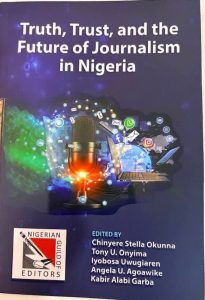
Title: Truth, Trust, and the Future of Journalism in Nigeria
Publishers: Premium Times Books and the Nigerian Guild of Editors (2026)
Editors: Chinyere Stella Okunna, Tony U. Onyima, Iyobosa Uwugiaren, Angela U. Agoawike and Kabir Alabi Garba.
Pages: 394
Reviewer: Dr. Oyegbile
••••••••••••••••••••••••••••••••••••••••••••••••••••
WHAT IS TRUTH? WHAT IS TRUST?
If you have the truth, you are trusted. If you are trusted, it means you have the truth. The two are mutually exclusive. You can’t have one without the other. Journalism is a profession; some say it is a vocation. Whichever one you call it, journalism cannot do without the two- Truth and Trust; they are like the Siamese twins. They are inseparable. A newspaper is called Daily Trust, another, The Guardian, takes its motto from the immortal word of Uthman Dan Fodio which says, “Conscience is an open wound, only the Truth can heal it.”!
It is therefore not a surprise that the Nigerian Guild of Editors (NGE) is today presenting to the world a book titled Truth, Trust, and the Future of Journalism. Let me state the obvious: journalism without these two ingredients: Truth and Trust, has no future. Most of us here today are old enough to remember a magazine called Akapa’s World. It was published in the late eighties and early nineties when the world of magazine publishing was the rave. What killed it? Lack of Truth and Trust!
You will remember that it came out with an edition, which claimed a certain Nigerian girl resident was a girlfriend to Michael Jackson! The same Michael Jackson, the greatest Pop Music sensation of all times with a Nigerian as girlfriend? It was the biggest news of the time. The magazine was an immediate sell out. If my memory serves me right, it went into several reprints because readers demanded for more copies. Akapa’s World outsold all news magazines of the time in Nigeria. I am sure most editors of news magazines of that time would have wondered why they missed such a “World Exclusive”.
As my people would say, “Ti iro balo ni ogun odun, ojokan ni otito yio fi ba.”, which roughly translates as, “If lies travels for twenty years, it takes a day for truth to overtake it.” The eighties was not a time of Internet, so news travels not by a click of a button. Newspapers published in the United Kingdom arrives in Nigeria two or three days after, not to talk of those published in the Americas and other far parts of the world. A few months later, perhaps after the magazine had circulated in the United States of America and other parts of the world, the truth caught up with it. Michael Jackson had no girlfriend going by the name the magazine published nor a Nigerian girlfriend!!!
What killed Akapa’s World? Lack of Truth and Trust!!! Simple.
It is against this backdrop that I intend to dissect this book today. The NGE has assembled field experienced editors to consider these two great ingredients and the future of journalism. Of recent, there have been fears that journalism is dying, not only in Nigeria but across the world. Technology has advanced journalism, some argue, and it has at the same time served as its death knell.
In 14 chapters, each of the writers deals with the issues approaching them from different perspectives under the three sections it is broken into. The three sections are: Section one deals with: Truth: The Foundation of Credible Journalism with four essays. Section two is on: Trust: Rebuilding Trust in the Media, with five essays, while the third is on: The Future: Reinventing Journalism for an Evolving Media Ecosystem which is made of five essays.
The first article, “The Enduring Principles of Journalism” by Lanre Idowu, deals with the cardinal rules of journalism which have not changed and would never change despite the changing atmosphere in which the profession operates. According to him, “Good journalism is knowledgeable, credible, trustworthy, and sustainable… Bad journalism by contrast, conflates fact and fiction, privileges convenience over rigour, and often succumbs to vested interests” (P3-4). He lists out these enduring principles and the challenges they face, not leaving out how to surmount them.
Akpandem James in his titled “Journalism in the Age of Misinformation, Disinformation and Deepfakes” tackles the Hyra headed monsters of disinformation and disinformation as earlier narrated in the Akapa’s World magazine story. He declares that we are on the threshold of when. “The news environment has become toxic, and consumers are constipated.” (p19). He posits that the unregulated environment in which journalism operates has led to a situation where, “non-journalists now compete with, and even rival, trained journalists in content creation and distribution, often disseminating toxic material that undermines organized society and erodes public trust in the media.” (p21).
What does he think is the way out? According to James, digital technology which he sees as the profession’s Achilles’ heel has advanced the practice and to mitigate “The negative fallout of the digital media and sanitizing the communication landscape require an inclusive stakeholder-led approach. Strengthening the professional capabilities of journalists is not merely technical but foundational to maintaining an informed citizenry.” (p36).
In Chapter three, Kabir Alabi Garba focuses on: “Investigative Journalism in Challenging Environments.” Whether in a democracy or autocracy, investigative journalism is the torchlight to development and societal growth. However, since the return of democracy in 1999, opinions have remained divided over whether this genre of journalism thrived more under the military than in a democracy. The answer is blowing in the winds.
In tackling this, Garba observes that to sustain investigative journalism, there must be legal reforms, sustainable models of funding, regional collaboration and cross-border networks among others. In conclusion he avers that, investigative journalism helps to build public trust and that “it is not a luxury of democratic maturity; it is a precondition for it.” (p66).
In the closing the first section in Chapter four, Sule Yau Sule’s “No Spin Zone: Why Journalism Must Resist Public Relations’ Influence,” is a chapter every journalist MUST read and study with a fine toothcomb. It dissects the issue in a very matured and distinctive manner. I recommend its reading because many journalists are today more of public relations practitioners than journalists! This is not meant as an insult. Public Relations is not Journalism and vice versa.
Sule declares, “Journalism exists to provide accurate, verified and balanced information that enables citizens to make informed decisions; it promotes transparency, and holds individuals and institutions accountable.” (p72). That is journalism.
So, what is Public Relations? He writes, “Public Relations, by contrast, is primarily concerned with managing communication on behalf of organizations to protect their reputation, foster mutually beneficial relationships with stakeholders and influence public perception.” (p72). Any surprise why the media is shrinking? We have allowed the two to intersect and the thin line that separates them have become too blurred and unnoticed even by journalists and PR people are riding on this. However, our discerning readers and viewers can see those lines which we pretend not to seen.
• Dr Oyegbile is a journalist, writer and media scholar. He can be reached at: yinka2005@gmail.com.
To be continued tomorrow