

Homage: Return To Familiar Places – The Memoir by Chidi Amuta; Wilson & Weizmann Associates Limited, Ikeja, Lagos, Nigeria; 2025; 492pp
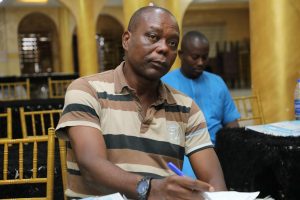
Reviewed by Maxim Uzoatu
It can indeed be overwhelming when an individual packs many lifetimes into one lifespan. Dr Chidi Amuta in his memoir, Homage: Return To Familiar Places, delivers a vast range of events, subjects and accomplishments that can destabilize any reviewer. Amuta belongs to the elite class of personages fit for Oscar Wilde’s quip, to wit: “The only thing worse than being talked about is not being talked about.”
The only child of his parents, Wilson and Grace Amuta, from the rural village of Umuguru – which translates to “children of the harmattan” – in Ngwaland, in present-day Abia State, Chidi Amuta started out from “ordinary beginnings” at birth on the dot of 9am, Friday, July 24, 1953 with his maternal grandmother not recalling “that there were any comets streaming across the dark rainy skies.”
The young lad had a dislike for school and schooling, but he was always first in the class. He was a southpaw, and the teacher went “to report the case of this boy who had chosen to write only with his left hand.” All harsh efforts to make him write with his right hand failed until he cried to his mother at home who asked the father to come back to the village from his Aba workplace with UAC to confront the oppressive teacher. The father who had been a Second World War soldier dressed up in full military gear to storm the school “to beat up a teacher for trying to stop his son from writing with his left hand.” A female teacher offered this defence for the boy: “He always comes first in the class while those who write with their hand are always at the bottom of the class. What was the sense in it all?” That’s how the young Chidi got his freedom – and the school even made him “jump a class and go on to join the next higher class.” The mother had earlier cried to the headmaster to withdraw her only child from playing football because of the fear of injury “and replaced it with a mortal fear of the game I had grown to love.”
It was while attending secondary school at Asa Grammar School, Aba, that a teacher named Mr Moses Onwuma decreed that no student should henceforth bear a foreign name. According to Chidi Amuta, “I went to Asa Grammar School as Friday Amuta, a name chosen by my parents to commemorate the fact that I was born on a Friday… I returned on my first holiday as Chidi Amuta. Friday was buried. Chidi was born at Asa Grammar School and has lived to this day.”
There’s the interesting matter of the mathematics teacher, Mr Ukata, who damned Amuta’s poor performance in math until the student perforce “realized that my status as a distinction candidate could only be confirmed if I scored a credit in Mathematics.” Amuta’s sterling school certificate result “remained a record for many years after I left Asa High School in the post war years.” Now, let’s take in this downer: “Meanwhile, Mr Ukata returned from the war with a changed name. A clear unmistakable Igbo man before the war, Mr Ukata returned after the war as Mr Halliday, an adopted Rivers name which he took in order to attract government benefits as an indigene of the riverine minorities. It was fashionable not to be seen as Igbo after the defeat of Biafra in 1970.”
The Biafra war struck at the growing pains of Chidi Amuta. His adolescent love interest, Priscilla, got married off to his chagrin, and he lamented thus: “Unknown to many around me, the war had just claimed its first costly emotional casualty: ME!” He would later get conscripted by the raiding Biafran soldiers while eating in his mother’s kitchen, and was taken in a vehicle “to the training base at the secondary school Umumkpeyi.” When his father learnt of his son’s conscription he headed straight to the base where the camp commandant was a fellow Second World War veteran called “Iron Bar”. When the camp commandant saw Amuta’s father he froze in alert salute, and promptly released the young Chidi to his father.
After the war woes, Amuta returned to school and made a distinction in his secondary school certificate examination, and was admitted into the then University of Ife, “enrolling for a course of study that would give me access to a government scholarship to relieve my poor father of burden that would ordinarily be borne by a whole community.” Amuta witnessed the Students Union election in which a candidate named Jide Adeniyi Jones was only Yoruba in name, having been born and bred in Aba – he spoke against using the election “to undermine the unity and national solidarity on campus through the promotion of divisions along ethnic lines”, and “concluded by greeting the students body in English, Yoruba and then fluent Igbo.” He won the election and was carried around the campus by Igbo students chanting: “Nzogbu Enyimba Enyi!!!”
Amuta who graduated with a First Class from Ife in 1977 was posted to Kano State to undertake his NYSC year as a lecturer at the College of Education of the then Bayero University, Kano. He became a proud owner of a white brand-new Volkswagen Passat GLS upon taking up employment as a Graduate Assistant in the Literature in English Department of the University of Ife. When he took the car to Aba his astonished father undertook to drive it to their Umuguru village home to celebrate the local boy who made good.
It was a case of love across the Niger when the Igbo Chidi Amuta chose to get married to the Yoruba lady Tosin. The renowned radical scholar Biodun Jeyifo (BJ) used his battered Volkswagen Beetle to take Amuta and his colleague, GG Darah, to meet with Tosin’s father in Osogbo. The suitor and his companions were fiercely driven away at first asking by an irate future father-in-law, but the marriage eventually happened.
Amuta later transferred his services to the University of Port Harcourt where he discovered that the Social Sciences section was dominated by a radical leftist ideological bent led by Claude Ake and Ikenna Nzimiro while the Humanities had to make do with a conservative tradition. Amuta’s deposition that “Charles Nnolim had built a reputation on a disputation over the possible sources of Chinua Achebe’s Things Fall Apart” ought to have been “A Source for Arrow of God”, and not Things Fall Apart. A prominent student of his at UniPort was Rotimi Amaechi who later became the Governor of Rivers State and is today a Vice-Presidential Candidate.
Amuta is the lionized author of Towards A Sociology Of African Literature and The Theory Of African Literature. He did not feel quite fulfilled just teaching as he “craved a larger audience in which my words and ideas would make a difference in people’s lives or at least in the decisions that affect the lives of the people whose lot I was ideologically committed to improving.” Journalism became his next port of call, and The Guardian Editorial Board was the place to be in Lagos with fine minds such as Stanley Macebuh, Yemi Ogunbiyi, Onwuchekwa Jemie, Godwin Sogolo, Femi Osofisan, Sonala Olumhense etc.
He had a short one-year stint as the head of the Directorate for Food, Roads and Rural Infrastructure (DFFRI) in Owerri, Imo State before joining up with his friend Yemi Ogunbiyi who had been appointed the MD of the Daily Times Group. He distinguished himself as the Chair of the Editorial Board, and was invited to the seat of government in Dodan Barrack, Lagos by Military President Ibrahim Babangidawho had read his insightful articles like the one titled “Ibrahim Gorbachev”. Amuta had the privilege of a stint understudying Babangida at work, and eventually wrote the book Prince of the Niger, only for him to find out “that most of those who were condemning the book had either not seen a copy or read a paragraph of it.”
He resigned from the Daily Times in solidarity with Ogunbiyi who had been unceremoniously sacked by the Babangida government. Amuta worked with Ogunbiyi in his Tanus Communications before teaming up with Stanley Macebuh to set up The Post Express under the sponsorship of Chief Sonny Odogwu. After quitting The Post Express, he set up his own company, Wilson & Weizmann, whereupon he “went to visit a friend who had previously played a major role in leading our country… he dipped his hand into his pocket and handed me a cheque of N5 million.” He was determined to prove the point of turning “words and ideas into merchandise.”
Amuta enjoyed ready access to powerful Nigerians, not the least of who happened to be Chief MKO Abiola. In the run-up to the June 12, 1993 election, Amuta was a co-editor with Yemi Ogunbiyi of the collected speeches of Abiola entitled Legend Of Our Time. Abiola “insisted that the foreword for the volume had to be written by Dr. Nnamdi Azikiwe, Nigeria’s founding President whom he adored, admired and highly respected.” Amuta received illustrious guests at his Ikeja home such as Abiola and Wole Soyinka who had an “unusual capacity to handle spicy hot sauce.”
A survivor of near-death attacks intervolving glaucoma, diabetes, cataract, hallucinations, and 8-plus surgical procedures across three continents, Amuta is now in fine fettle with “active work: reading, writing, travelling and living with a near normal vision for my age.” He had storied encounters with world leaders such as Robert Mugabe of Zimbabwe, Yoweri Museveni of Uganda, and President Dawda Jawara of Gambia.
The author of Homage: Return To Familiar Places, Chidi Amuta is blessed with six children made up of three boys and three girls. Homage: Return To Familiar Places is undoubtedly a splendid book, a memoir in a class of its own, capped with 94 pages of index!
