

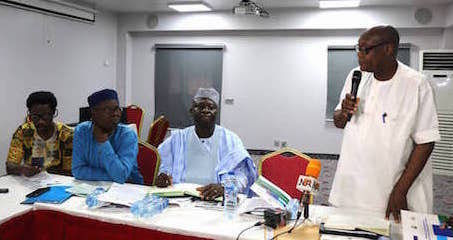
L-R: Prof Ayobami Ojebode of the Dept of Communication and Language Arts, University of Ibadan, Ibadan; Dr Akin Akingbulu, Executive Director, IMS; Prof Armstrong Idachaba, Ag D-G, NBC; Mr Eddy Emessiri, Executive Secretary of Nigeria Election Debate Group/ BON, at the 2-Day Retreat, Lagos.
By Ayo Kehinde
Against the backdrop of lessons learned in the coverage of the 2019 elections, participants at a 2-Day retreat on the performance of the broadcast media have canvassed more professionalism as key to efficiency and quality delivery in the coverage of future elections.
The retreat, which held in Ikeja, Lagos on Monday 6 and Tuesday 7, was organized by the Institute of Media and Society, IMS, as part of the Support to Media component of the European Union Support to Democratic Governance in Nigeria (EU-SDGN) Project, with the theme: NBC-BON Post Election Lessons Learned Retreat.
This event brought together teams from the broadcast media regulator, the National Broadcasting Commission, NBC, the industry coordinator, the Broadcasting Organizations of Nigeria, BON, and other media stakeholders in the print, electronic and online sectors to review the performances of the broadcast media and the regulator during the 2019 electoral process, as well as discuss issues around the proposed review of the Electoral Act.

Participants: L-R: Mrs Stella Erumhunse, Mrs Gloria Makinde, Mrs Franca Aiyetan, Mr Amos Esele, Mr Aminu Indabawa
In his welcome address, Executive Director of the IMS, Dr Akin Akingbulu reminded participants of the need to make robust contributions that would form part of recommendations for ongoing reforms in the electoral and broadcast media sectors in the country.
He said: “…About 18 months ago we had the privilege of hosting a similar event in Kaduna, in the Northwest of the country. Coincidentally, the man who made it happen at that difficult time because of work at the NBC, was Prof Idachaba. As we gather in Lagos for another similar event one cannot but recall with nostalgia the lively, cordial and productive atmosphere at the Kaduna event and express the hope that this Lagos event reach greater heights.
“The activity for which we have gathered is part of the project titled the Support to Media Component of the project sponsored by the EU. The component being handled by the IMS works to strengthen the media, to provide fair, accurate and ethical coverage of the electoral process in Nigeria.”
He reminded participants that the talks at the 2-Day event would generate advocacy for an improved performance of the media and the regulator in future elections.
In his opening remarks, Professor Idachaba hailed the smooth working relationship among the IMS, BON, NBC and other media stakeholders and solicited for the continued professional relationship to advance the broadcast industry in the country.
He said; “I want to single out the IMS among other partners who have invested resources on the training of staff of the regulator. I recall the trainings IMS conducted for NBC staffs in Kaduna, Kaduna State and Akwanga in Nasarawa State ahead of the 2019 elections. We have made the literatures available to staff. I urge all of us at this retreat to identify policy issues that need to be looked into before the 2023 polls, come out with a literature that would be make critical inputs into ongoing reforms.”
He assured the participants that the Minister of Information and Culture, Lai Mohammed “is committed to reforms just as the Board of the Commission.”
Moderator of the 2- Day event, Professor Ojebode, started the first day of the event with three topics, namely a review of the state of the broadcast media in the run up to the 2019 elections; Statutory Initiative in the 2019 elections and After; and Overview of the Media in the 2019 elections.
According to him, a survey, conducted 12 months to the 2019 polls, involving BON, the Nigeria Association of Women Journalists, NAWOJ, NUJ, Journalists, listeners and viewers across the country, discovered that radio was the preferred choice of the electorate when it came to clarity of information, confirming the veracity of news and following up on stories. This was closely followed by privately- owned TV stations and online mediums, which upload videos in addition to news materials.
“Private radio and TV stations were considered freer in giving authentic information unlike government-owned stations,” Ojebode said, noting that “ many government-owned stations were not well taken care of, many privately-owned stations did not have the required personnel”.
On the readiness of their stations and themselves for the coverage of the 2019 election, journalists, the survey found, were concerned with issues of security, staff welfare, requisite training and poor equipment. “The greatest source of worry for journalists preparing to cover elections was safety and security at 67 percent,” he said.
“Even top management staff interviewed were confused about what to do with voter education. Some said it was the duty of the Independent Electoral Commission, INEC, others said it was the National Orientation Agency, NOA. But this is supposed to be a partnership.”
The moderator concluded with what he called early warning signs of trouble to look out for, 12 months to election coverage.
They are presence of journalists on election duty with little knowledge on conflict reporting; a large number of journalists who need training on hate speech; journalists who worry about their safety; citizens who depend on private stations for information and delayed voter education.
Participants thereafter took turns to contribute, comment and make suggestions on the survey and related matters.
In his contribution, Mr Eddy Emessiri, Executive Secretary of Nigeria Election Debate Group/BON, noted that improper training is a major problem in the broadcast industry along with sustained funding, particularly for the private stations and expressed the hope that with the ongoing electoral and constitutional reforms and new changes in the proposed NBC Act, “its implementation could open doors to new sources of funds, If for instance, radio and TV license fees hitherto collected by states and local governments, are collated by NBC and shared according to spread of stations across the country.”
In his view, Imoni Amarere of DAAR/AIT station, identified what he called “fire brigade approach” method of preparation for election coverage as one of the reasons for poor reportage in print and broadcast media.
He said, “There are many untrained journalists in the media. Reason is that people see journalism as a stopgap. Stations do not invest in their training and journalists do not invest in themselves. Even when there is training it is usually for the staff at the head offices.”
He tasked journalists to fact-check stories before publication and broadcast and called on the electoral umpire, INEC, to partner with the media on time to avoid the observed lapses in information dissemination, voter education before, during and after the conduct of elections.
He said from experience, the NBC/BON coordinated train the trainer sessions for the media before coverage of polls should be strengthened by in-house trainings by media houses and peer review among stations.
On the second topic of the first day, Statutory Initiative in 2019 Elections and After, the NBC team showcased their efforts. To avoid problems that arose in the 2015 polls, the NBC team said, the Commission together with INEC undertook sensitization of the political parties and stations on the do’s and don’ts of the NBC code, printed and shared posters on ethics on election coverage and advertising which stations were encouraged to display conspicuously.
Zonal directors of the Commission were moved around to avoid emotional attachment to their zones. Their mandatory reports sent regularly to a central monitoring unit at the head office in Abuja, headed by the Director, Broadcast Monitoring but supervised by the DG, formed the basis for the sanctions meted to stations, which violated the codes during and after the 2019 election.
According to the Commission’s Director, Communications, Franca, Aiyetan; “There were collaborations and regular meeting between NBC and INEC and decisions on zonal reports were taken immediately and very many stations were sanctioned for infractions.”
Though the Director of Broadcast Monitoring of NBC, Dr. Tony Anigala disclosed that hate speech was becoming a controversial subject globally and urged stations to follow the definition in the Commission’s code, Olufisayo Oguntuyi, Moderator, Political Updates on NTA, Abuja, suggested the problem can be solved once there are agreeable standards on what constitutes hate speech and urged stations to invest in new technology that can detect and delete swear and hate words.
For Qasim Akinrete, Chairman of the NUJ, Lagos Chapter, BON and NBC need to look into two critical areas bordering on professionalism. He urged BON to seek out avenues for funding such as the Georges Soros and McArthur foundations funds that have benefitted the print media and avoid being compromised by what he called ‘toxic funds’ that usually come from questionable politicians during election.


PIX 1) L-R; Mrs Lydia Ekije, Mrs Adeola Ekine, Prof Ayo Ojebode, standing. Pix 2) Dr Tony Anigala, Mrs Stella Obi and Mr Abunakar Kumo
He urged the organization to send the right people for training and the NBC to conduct background check on owners of stations before issuing licences to them. He recommended the Ghanaian Commission model for Nigeria, which he said is “professionally run by core professional that had been vetted.”
Towards this end, he urged the NBC and BON to be involved in programme planning sessions of stations, to use of sanctions as last option and regularly conduct town hall meetings on their activities to sensitive viewers and listeners.
“The NBC can also distributes its codes to media students before their graduation as part of measures to have well-rounded professionals.”
Day two was a more practical session. The topic was the regulation and strengthening of the media profession for future elections.
The participants broke into four groups to examine the above topic under four key areas, namely, government and government agencies; trade unions: NUJ, RATTAWU, NAWOJ; the EU and other funders, NBC and BON; and finally, the individual Journalist and CSO.
Before the close of the retreat, participants agreed on some suggestions on Electoral Law Reforms.
These included the need for statutory requirements for the selection of candidates participating in political debates; insurance cover by media organizations for journalist on election duty; proper funding; law mandating media, advert agencies, digital platforms to report advert spent to regulatory authorities for transparency and voter education for and by the media.
Those who attended the event included Dr Akin Akingbula, Executive Director, IMS; Professor Ayobami Ojebode, lecturer in the Department of Communication and Language Art at the University of Ibadan, Professor Armstrong Idachaba, Acting D-G of NBC, Mr Eddy Emessiri, Executive Director of Nigeria Election Debate Group/BON; Mr Mac Amarere, DAAR Communications, Abuja; Dr Qasim Akinreti, Chairman of the NUJ, Lagos Council; Mr Chibuike Oguimike, Zonal Director, NBC, Lagos; Mohammed Sanusi Ibrahim, ARTV, Kano; Mr Raphael Akpan, Zonal Director, NBC, Ibadan.
Others are Abubakar Umar Kumo, Zonal Director, NBC, Kaduna; Mrs Susan Obi, Zonal Director, NBC, Enugu; Dr Tony Anigala, Director, Broadcast Monitoring, NBC, Abuja; Mrs Adeola Ekine, Chairperson of NOWAJ, Lagos Council; Lydia Eke, Editor, Unilag Radio, Aminu Garba Indabawa, Wonderland TV, Kano; Amos Esele, Editor-in Chief of Thisage, an online publication; Mrs Franca Aiyetan, Director, Public Affairs, NBC, Abuja; Mrs Gloria Makinde, Ag Director, Investigation and Enforcement, NBC, Abuja; Mrs Stella Erunmhunse, Ag Director, Broadcast Policy, Monitoring, NBC, Abuja; Tunde Saki, NTA, Olufisayo Oguntuyi, Moderator, Political Update, NTA, Abuja; Jude Nwabuzor, Head of Current Affairs, Galaxy TV, Lagos; Ademola Lawrence, TVC News, Lagos.
Isaac Ayodele, The Nation Newspaper, Lagos; Wilson Omoniyi, STV, Lagos; Gladys Haruna, FRCN, Lagos; Patrick Okafor, STV, Lagos; Margaret Mwantok, The Guardian, Lagos; Kabir Alabi Garba, The Guardian, Lagos; Ifeoma Agbapuonwu, AIT, Lagos; Sunday Aikulola, The Guardian, Lagos; Sanmi Folabi, IPC, Lagos; Olusegun Samuel, IMS, Olaniyi Olaniyan, IMS were also there.
