

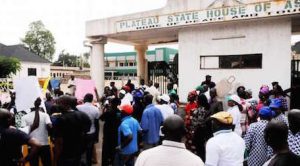
It is no longer news that Mangu, Bokkos, Barkin Ladi and Riyom have become killing fields. It has been like this for more than two months running, and this is not to forget the other years, which had been plundered by the locust. That it has not abated remains a matter for concern for all who value human life.
Since April 2023, Mwaghavul land of Mangu has come under intense attacks. The other local government areas that have come under fire this year and its continuing are Bokkos, Barkin Ladi and Riyom. All sane people feel that this must stop; human life should matter to us, and whoever that has targeted the state for continuous pounding.
No day passes without a post or two from various points of concern in the new media of impending attacks targeted at one community or another. And truly they had come to pass, leaving the people with lamentations and followed by superfluous condemnatory statements from governments, individuals and organizations. We must ask, what then should be done?
Even if the posts were made up ostensibly to raise alarm, we have arrived at the most critical point that such ‘alarms’ should be investigated. They may provide the leeway to helping Plateau State communities return to peace, and at best bring perpetrators to justice.
The question to ask is: What may not have been done by the security personnel to get to the root of the attacks all these years? Difficult as the question has remained, it leaves the state with the moral burden of what to do to unravel the identities of the attackers and bring them to justice.
I have not only imagined, but seriously thought that there is much left to be done to stem the tide of attacks against communities in Plateau State.
Repeatedly the press has been rightly inundated with calls from Mangu on how their plight can be sent out to the world. Since the attacks started in some villages in the local government area, yours sincerely has had the opportunity of crying to the world several times over. The fact that our compatriots are daily decimated in the most atrocious manner should worry all of us.
There is nothing in this part that is now a secret to the world; what is needed is to unravel the forces behind the onslaught against the state and its people. Nothing would make the people better assuaged than for the killers to be identified.
The losses incurred, particularly of human lives cannot return. The hardships and indignities survivors have gone through can only be imagined, just as property lost may be a temporary setback for most of the families; and by extension the communities. What is on the minds of people of the state and other sane human beings is to have an end to this recurring madness.
All the attacks have not come through happenstance; they are a product of coordinated plans made over the years; if not, pray say; why have the attackers been able to easily penetrate communities hitherto thought to be impenetrable? Do they have collaborators in the communities that are targeted for attack? If there are, by now, some of them may have been identified.
Initially tagged ‘unknown gunmen’ over the years, what later emerged was the sophistication that came with the manner of the attacks. If the attacks were initially labeled farmers/herders’ attack (and we know they are not), how come, it is the natives that are mostly the victims?
Why is it that the (attackers) come only when natives in those communities are preparing for the wet season? Has anyone thought about the colossal destruction recorded in various communities apart from the inability of the farmers to access their farmlands during the rainy season over the years?
Only recently, this atrocity came to the fore again at Ta-hoss of Riyom, when unknown men visited farmlands nearing harvest and cut crops in the most despicable manner. As usual, no one has claimed responsibility, but the owners are ruing in pains and regrets. That of Farin Lamba in Jos South July 9, 2023 took away seven precious lives.
Indeed, many have continuously interrogated to know why nothing has been allegedly done by the security as fingers have been pointed on a settlement called Mahanga in Barkin Ladi local government area. Repeatedly, allegations of the place serving as an armoury, safe haven and a launching pad for the bandits may have remained largely not investigated.
It was such a near acceptable postulation until the real colours and motives of the attackers became manifest to people. After series of violent attacks in the state, and knowing that the state does not control the security apparatus that Governor Jonah David Jang initiated Operation Rainbow. The security outfit was initiated to protect communities by giving them a sense of safety.
Air-Vice Marshal Bala Golgak Danbaba became Operation Rainbow’s chairman and supervised the organization’s day to day running from 2010 to 2015. A robust and steady responsibility of coordination and setting up the modalities needed to implement the road map took center stage from 2010. Sadly, for those who know, the organization has gone through hell, for after 2015 there was scarcely anything about the organization that was heard about its operations.
The state security outfit, like Amotekun in the south western part of the country was an idea whose time was ripe, and had come to play a pivotal role in Plateau keeping communities safe from any attack.
Operation Rainbow remains perhaps the only state security outfit in Nigeria that had an approval from the Presidency, hence its formation in 2010. It was created specifically for intelligence and early warning mechanism by checking possibility of threat to life and property.
No one should be reminded that the state has been under severe attack for over two decades. The sad aspect as we are aware is the inability of the state to have sustained the operations of the organization. I had written elsewhere that the price the state is paying now cannot be far-fetched: We may have taken things for granted, believing that it was calm, and ‘not knowing that it was the calm before the storm’.
Continuing, someone had posted on a new media platform thus: We are cut napping and left to scatter in disarray like sheep without shepherd. Amidst the granting of the means to secure ourselves, to assist the government to assist us we are crying foul.
‘What else do we need from the federal government more than this? I think the negative tendencies of Plateau politics caused the limbo of Operation Rainbow because it could be that some elements thought that it was created on political party sentiments to protect a given ethnic group(s) and region (s)’.
The conclusion of the matter is exciting as it lays bare what I have always advocated in the past: The reactivation of the Operation Rainbow is long overdue to assist in the defeat of this menace ravaging our land and people. Our energy, time and resources should be channel to re-jig the outfit for optimum performance because it is a battle for survival as a right to life and to live. What is needed is the appointment of men and women after the heart of Plateau.’
For over two decades, most communities in Plateau have come under attack by bandits; killing and maiming men, women and children as well as destroying property, all in a bid to take over ancestral lands. The idea to have a state security outfit was to complement the services offered by the conventional military and police. It received acceptance as soon as it was mooted; and before long, it became law for the good of the state.
Many remember that at the time of its establishment, it was wrongly perceived by some people that it would be used as a means to settle local scores; however, as soon as its operations hit the communities, it was apparent that the idea was for the good of all. To think that in the last eight years, it became moribund and attracted lots of criticisms to the government from citizens is sad. They consistently have wondered why it was laying waste while lives were being wasted in the communities where its presence should have made the difference.
We have never been known for savagery, however to remain silent in the face of the atrocities against the people is rather indifferent. It is possible not to take up arms against the state; however, it is right to assist in all manner of ways that are genuine and legitimate to contain the onslaught and stem the tide of the attacks.
The recent skirmishes which led to a curfew in Mangu town by the authorities of the local government area were, if anything, instructive and revealing of how often relationships break down irretrievably as a result of lack of trust. The circumstances of the breakdown of law and order in Mangu town are known and well documented. What we have waited to know is the degree of punishment meted to those who were caught vandalizing shops and property in the town while the curfew lasted.
During the breakdown of law and order in Mangu, apart from the condemnatory notes, certain groups which are desirous of adding their voices to the impasse gave other details that may not be given by government or security agencies. Without being oblivious of efforts of the security, it is important to state that such efforts from the field must have enabled others access the indignities they went through with a view to helping them.
Hardly had the Mwaghavul Development Association concluded its press briefing on July 8, 2023 than Sabon Gari and Mararaban Pushit came under severe attacks leaving in their trail scores of death (about 12 persons). The assurance from the new GOC and OPSH Commander, Major General AE Abubakar is anything to go by; it is believed hope is in the air. It is understood that at the time of going to press, he remained in Mangu to take full charge of operations.
The group, Global Society for Middle Belt Heritage headed by Comrade Jerry Tongle Joshua has not minced words since the attacks started. In a press conference which was held TEKAN Headquarters in Jos a couple of weeks ago, the organization insisted that the Operation Safe Haven (OPSH) personnel have no business being in the state on the mission of protecting people. They accused the STF of running businesses rather than securing lives and property of citizens; as such, they should be withdrawn and replaced with Mobile Police at check points in the state.
As a result of the attacks in Mwaghavul land alone, they disclosed that about 40,000 internally displaced persons are scattered in Mangu, Panyam, Mangu Halle, Yilpo (Sabon Gari), Fan in Barkin Ladi, Maikatako, Mariah in Bokkos and Bukuru in Jos South as well as in Jos North. The attacks on ‘Mper of Bwai and Kogul community of Panyam on July 7, 2023, must have added the number.
Those have a story to tell, however, what about the 276 dead bodies and still counting that were killed across 39 villages or even more? These figures were released by the group, even as they asked questions about three phones snatched at the Mangu Police station and those that were allegedly arrested with firearms.
There are many questions, but few unsatisfactory answers have been provided. On account of this development, we cannot continue to live in this fearful situation, as no one is safe any longer. It is on this note that the urgency to surmount stakeholders to a meeting by Governor Caleb M. Mutfwang has become necessary.
If there is a rallying point without borders, which is lacking presently; it is possible to see each other’s predicament as our concern. Like it or not, the state is in dire need of a voice.
At this stage the state has become more divided than it used to be, it is about time communities in the state are brought together to dialogue with one another toward finding a lasting solution to this intractable cul-de-sac.
Mr Gobum is a former NUJ chairman and Sunday Editor of the Nigeria standard newspaper in Plateau State.
