From Yakubu Busari, Jos
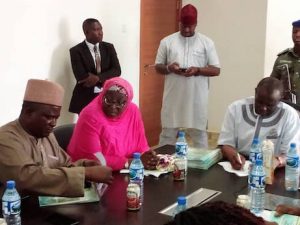
Prof Atu, Dr. Hamza and Prof. John Wade Director, Research & Documentation, Government House at the event yesterday.
The Secretary to the Plateau Government Prof Danladi Abok Atu has said the government is going to domesticate the National Social Protection Policy to stimulate growth and development of small scale and entrepreneurial skills in the state.
Atu, made the pledge in a remark after receiving briefing by Dr Sumaye Hamza, the Focal Person, Social Investment Programme (SIP) in the state.
Atu described the policy as “very unique” and “impactful” on the lives of citizens and the infrastructure development of the nation, adding that
“It is in view of this that this administration under the leadership of Gov. Simon Lalong is keen in domesticating the National Social Protection Policy.
“We have seen its impact on our teeming youths and vulnerable poor in the state which has given room for the peace being enjoyed.
“This government is passionate about it knowing quite well that it will boost the social well being of our youths and infrastructure development of the state,” he said.
Earlier, during her briefing, Dr Hamza said the components of SIP which include: Job Creation -NPower, National Home Grown School Feeding- NHGSF, Conditional Cash Transfer – CCT and Government Enterprise Empowerment Programme- GEEP, would turn the fortunes of the Nigerians around soon.
“Government is committed to ensuring that citizens of Nigeria are supported to boost their economic status and subsequently get out of poverty.
“SIP objectives include: Boosting productivity, especially amongst the marginalised and the vulnerable, including women, stimulating economic activities in unreached areas, helping to create sustainable jobs, improving livelihood, enhancing financial inclusion and ultimately reducing poverty.
She stated that under the Conditional Cash Transfer, over 11,000 poor and vulnerable households in six local government areas – Jos East, Bassa, Bokkos, Kanke, Langtang North and Wase, are receiving N5,000 monthly.
“Over N2 billion has so far been injected into the economy of the state through these Poor and Vulnerable House-Holds in the six local government areas. The selection of the local governments and beneficiaries was done using a globally accepted methodology of high integrity.
“Again, under the CCT called Co-Responsibility where almost 4000 lactating mothers, pregnant women and households with zero to five years children who attend antenatal and receive immunisation with evidence are receiving additional N5, 000.00 monthly.
“This has tremendously improved the well being of members of the House-Hold. It will enhance the number of pregnant women who attend antenatal clinics and subsequently deliver in Health Care facilities, thus reducing maternal and infant mortality/complications.
“We are currently working in the remaining eleven local government areas where over 80,000 poor and vulnerable House-Holds have been enumerated and enrollment has commenced. Once they are enrolled and data synchronised, they will begin to receive the monthly stipends of N5, 000, ” Hamza said.
She said the Social Investment Programme had tremendously improved the economic status of citizens, provided jobs, improved agricultural activities, made our young graduates “to think outside the box” and enhanced financial inclusion.
According to her, “to enhance expansion and sustainability, it is important to domesticate the National Social Protection Policy in the state.”