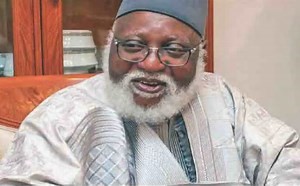
By Ayo Kehinde
Nigeria’s former Head of State, General Abdulsalami Abubakar, has become the butt of viral social media reactions following his appearance in promotional materials by an Indian hospital after his knee replacement surgery at the facility.
The video, which has gone viral on social media, shows the former Nigerian military Head of State and currently Chairman of pro- democracy National Peace Committee receiving care at Krishna Shalby Hospital in Ahmedabad, India, including footage of him walking and undergoing rehabilitation exercises after the procedure.
The hospital used images and videos of Abdulsalami’s recovery to promote its services to international patients, highlighting the treatment as an example of its healthcare offerings.
In an Instagram post on Monday, the Indian hospital said Vice President Kashim Shettima visited the facility and met with its management to discuss Abdulsalami’s progress and wellbeing.
The hospital described the visit as a reflection of “growing trust in India’s healthcare” and its commitment to treating patients from across the world.
When patients travel across borders for specialised care, their trust means everything,” the hospital said.
It is not immediately clear whether Abdulsalami’s treatment was fully sponsored by the Nigerian government.
The hospital’s use of Abdulsalami’s treatment in its promotional material has sparked reactions from Nigerians, with some questioning the development against the backdrop of Nigeria’s healthcare challenges.
Activist and presidential candidate Omoyele Sowore shared the promotional video on X, criticising the continued reliance of Nigerian leaders on foreign healthcare systems despite their years in public service.
“This is former Nigerian Head of State, General Abdulsalami Abubakar, being used in a hospital advert after undergoing knee replacement surgery in India,” Sowore said.
Barrister Aloy Ejimafor also reacted to the development, describing the hospital’s use of Abdulsalami’s image as a “diplomatic insult” in a Facebook post.
Reacting to Sowore post, an X user identified as R. Moore argued that the issue was not necessarily whether Abubakar could afford surgery anywhere in the world, but whether the episode reflected a lack of confidence in the healthcare system associated with Nigeria’s political leadership.
R. Moore described the situation as unfortunate for a former leader of a country with Nigeria’s resources and questioned where the wisdom lay in relying on foreign healthcare after decades of political leadership.
Another contributor, Dr. Bak, endorsed Sowore’s argument, attributing the situation to what the commentator described as decades of inadequate investment and neglect across critical sectors.
Dr. Bak described the development as an embarrassment for the ruling class and argued that the country continued to repeat mistakes that had contributed to its developmental problems.
An X user identified as Banilion similarly broadened the debate beyond Abubakar, arguing that Nigeria continued to repeat the mistakes that had kept it backward.
The user called for greater accountability and urged Nigerians to consider the consequences of present-day decisions for future generations.
Not all reactions, however, supported Sowore’s criticism. An X user identified as Biodun Adeyanju challenged the suggestion that Nigerians have to travel abroad to undergo knee-replacement surgery.
Adeyanju argued that such procedures are available in Nigeria and are already being performed at tertiary healthcare institutions.
He maintained that Nigerians with the financial capacity to travel should have the freedom to choose where they receive medical treatment.
“Everything is not about opposition politics and criticism,” Adeyanju wrote, urging Nigerians to seek information and knowledge before reaching conclusions about the capabilities of the country’s medical institutions.
His intervention shifted the debate towards an important question: whether the problem is the absence of medical expertise in Nigeria or the confidence of patients in the quality, accessibility and reliability of the available services.
Joint-replacement procedures are performed in Nigerian tertiary hospitals, although access to specialist services, equipment, costs, waiting times and the availability of particular procedures vary across institutions.
Another X user identified as Akan Mpah urged caution, pointing out that Abubakar headed a transitional military government for about one year before handing power to an elected civilian administration in 1999.
The commentator argued that if Abubakar chose to undergo the procedure abroad and paid for it personally, the more contentious issue was not necessarily his decision to seek treatment outside Nigeria but the alleged use of his treatment in foreign hospital advertising.
Post Views:
552