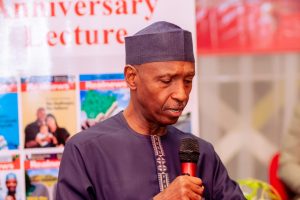
Dr Omar Farouk Ibrahim, Regional Chair for Africa, World Energy Council, has called on African countries to take responsibility for their energy future by strengthening financing, developing indigenous technology and building regional energy infrastructure.
Ibrahim made the call while delivering the 14th Anniversary Lecture of RealNews Magazine in Lagos on Thursday.
The lecture was titled: “Geopolitical Turbulence and Energy Security: Forging Strategic Opportunities for Africa.”
He said Africa’s energy insecurity was not fundamentally caused by a shortage of resources but by inadequate financial capacity, technological capabilities and market infrastructure.
According to him, the continent possesses substantial oil and gas reserves, enormous solar resources, hydropower potential, wind, geothermal energy and critical minerals.
He, however, noted that Africa continued to experience the world’s greatest energy-access deficit despite its abundant resources.
Citing the 2026 Tracking SDG 7 Report, which drew on 2024 data, Ibrahim said more than 560 million people in sub-Saharan Africa lacked electricity access.
He added that approximately 970 million people lacked access to clean cooking.
He identified financing, technology and market infrastructure as three major challenges confronting Africa’s energy sector.
The former Secretary-General of the African Petroleum Producers’ Organisation (APPO) said the organisation had commissioned a study during his tenure to examine the industry’s prospects amid changing international financing policies, technological trends and market conditions.
He said the study informed the conception of three initiatives: the Africa Energy Bank, the Central Africa Pipeline System (CAPS) and regional centres of excellence in oil and gas research and technology.
Ibrahim said geopolitical tensions, armed conflicts, supply-chain disruptions and the global energy transition had transformed energy from a mere commodity into an instrument of national security, economic resilience and geopolitical influence.
He cited the Russia-Ukraine conflict and the 2026 Middle East crisis as examples of developments exposing the vulnerability of international energy markets.
According to him, about 20 million barrels of crude oil and petroleum products transited the Strait of Hormuz daily in 2025, alongside a significant share of global liquefied natural gas trade.
He said disruptions along such strategic corridors affected prices, freight and insurance costs, trade balances and investment decisions worldwide.
The energy expert explained that higher crude oil prices could increase export earnings for African oil-producing countries but also raise the costs of imported fuel, food, equipment and transportation.
He said petroleum-producing countries remained vulnerable when they depended on imported refined products or lacked adequate domestic storage and distribution systems.
Ibrahim stressed that energy security should encompass reliable physical supply, infrastructure resilience, diversified energy sources, affordability and the capacity to withstand external shocks.
He also called for a balanced energy transition that recognised Africa’s development needs and different circumstances from those of industrialised economies.
He said African countries should expand renewable energy, improve efficiency and reduce emissions while responsibly utilising oil and gas for electricity, fertiliser production, petrochemicals and industrial development.
“Our energy transition must be a transition from energy poverty to energy prosperity, not from energy poverty to deeper deprivation,” he said.
Ibrahim said the International Energy Agency’s World Energy Investment 2026 projected global energy investment of approximately 3.4 trillion dollars, with about 2.2 trillion dollars directed towards clean energy technologies and infrastructure.
He noted that Africa’s share of the projected global investment was only 110 billion dollars, representing 3.3 per cent.
He said the financing deficit affected electricity generation, transmission networks, oil and gas production, refineries, pipelines, storage facilities and clean cooking infrastructure.
According to him, achieving universal access to clean cooking in Africa would require approximately four billion dollars annually.
He said reliable energy was inseparable from food security, employment, industrialisation and national stability.
Illustrating the economic consequences of the 2026 Middle East disruption, Ibrahim cited experiences in Nigeria, Egypt, Kenya, Ghana and South Africa.
On Nigeria, he said an International Food Policy Research Institute analysis covering January to June 2026 found that diesel prices increased by approximately 86 per cent in naira.
He described the increase as the highest among the 42 African countries examined.
He explained that higher diesel prices affected road transportation, agriculture, industrial equipment and backup electricity generation, consequently increasing food prices, transport fares and business costs.
On Egypt, Ibrahim said the country’s monthly natural gas import bill rose from approximately 560 million dollars before the conflict to 1.65 billion dollars in March 2026.
He said the increase placed pressure on foreign exchange and public finances.
He also cited Kenya’s regulated retail petrol and diesel price increases of approximately 16.1 per cent and 24.2 per cent, respectively, in April 2026.
For Ghana, he advocated stronger regional petroleum trade, including commercially viable supplies from Nigeria’s refining facilities.
He said South Africa’s experience demonstrated how higher international fuel prices could increase production and transportation costs and weaken industrial competitiveness.
Ibrahim said the experiences showed that Africa’s vulnerability depended not merely on its oil and gas resources but on its capacity to finance, develop, process, transport, store and distribute energy.
On financing, he said the Africa Energy Bank was conceived by APPO in partnership with the African Export-Import Bank (Afreximbank) to mobilise African and partner capital for energy development.
He said APPO and Afreximbank signed a memorandum of understanding for the bank’s establishment in April 2022, while its establishment agreement and charter were completed in June 2024.
Nigeria was selected to host the bank in July 2024, while its headquarters building and furnishing were completed in February 2026.
He said the minimum equity capital required for the bank’s take-off, amounting to five billion dollars, was raised by June 2026.
According to him, the bank was formally launched on Oct. 31, 2026, with the inauguration of its General Assembly of Shareholders, appointment of its first president and Board of Directors, and appointment of external auditors.
He described the development as an important institutional achievement for Africa but stressed that its success would depend on sound governance, professional management, prudent risk assessment, transparency and financial sustainability.
“The bank’s success will not ultimately be measured by the ceremony of its establishment. It will be measured by the projects it finances, the infrastructure it enables and the jobs it supports,” he said.
On technology, Ibrahim said Africa had relied heavily on externally developed equipment, software, technical services and expertise throughout its oil and gas production history.
He proposed regional centres of excellence to promote research, technology development and collaboration among African scientists, engineers and researchers.
He said the initiative would require sustained investment, coordinated programmes, host institutions, partnerships and effective governance.
On market infrastructure, he said APPO conceived the Central Africa Pipeline System to facilitate the movement of oil, gas and petroleum products among 11 Central African countries.
He explained that the project was intended to connect producers with consumers and support regional industrial development.
He said CAPS remained under development and would require political commitment, financing, commercial arrangements, harmonised regulations and sustained cooperation among governments and investors.
Ibrahim said the African Continental Free Trade Area provided an important framework for regional energy trade but required reliable cross-border energy infrastructure to realise its potential.
He urged African countries to strengthen strategic petroleum reserves and storage capacity, diversify supply sources and transportation routes, and improve domestic refining and processing.
Other recommendations included investment in electricity grids, cross-border energy links, emergency supply coordination, energy data, forecasting and contingency planning.
He also called for predictable regulatory environments, private-sector investment and targeted, transparent support for vulnerable households whenever energy price shocks occurred.
The expert proposed seven strategic priorities for Africa, including universal access to modern energy, diversified energy mixes, sustainable financing, indigenous technological development and accelerated regional energy infrastructure.
He also advocated stronger intra-African energy trade and regulatory cooperation, as well as an energy transition that would promote rather than deepen energy poverty.
He said financing, technology and infrastructure must work together to deliver energy security and sustainable development across the continent.
Ibrahim urged African countries to move from resource ownership to resource mastery, excessive dependence to strategic autonomy, and fragmented national energy markets to an integrated continental energy economy.
He said the future of Africa’s energy security must be shaped primarily by Africans themselves.