From Victor Osula, Abuja
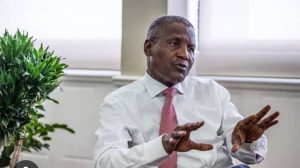
Founder and President/Chief Executive of the Dangote Group, Aliko Dangote, has identified erratic electricity supply and inconsistent government policies as major obstacles to Africa’s industrialisation.
Dangote made this known on Friday during a panel session at the ongoing 32nd Annual General Meeting of Afreximbank.
The session, which focused on the theme “The Path to Making Africa Great Again,” was moderated by CNN anchor and correspondent, Eleni Giokos.
The billionaire industrialist said Africa’s industrial growth has been stunted by chronic infrastructural deficiencies, particularly unstable power supply, and unpredictable government policy shifts.
He commended Afreximbank for its instrumental role in supporting the Dangote Refinery project, stating that with 10 similar institutions across the continent, Africa would become a global economic force within a few years.
“We are the only ones who can make Africa great. Yes, there will be ups and downs, but we must stay focused. It’s not just about amassing wealth, but about creating value through job creation,” Dangote said.
He recalled that during his meeting with Zambia’s Minister of Energy, Makozo Chikote, at the Dangote Refinery in Lagos earlier in March, he had shared how he studied the failures of past industrial efforts—including those of his own grandfather—before venturing into large-scale industrialisation.
According to him, power remains a fundamental challenge.
“If there’s no power, there won’t be growth. For example, anything I want to do abroad will cost me 30 per cent less because it’s plug-and-play—no need to build infrastructure.
“You just connect your factory to the grid. But in Nigeria, we had to invest heavily in electricity generation for the refinery and our other factories. This doesn’t happen in developed countries,” he said.
Beyond power, Dangote criticised frequent changes in government policies as another major stumbling block to investment and industrialisation across the continent.
“One of the problems is policy inconsistency. It’s like being a footballer about to score, and then the government moves the goalpost and tells you it’s now behind you. So you have to turn back and face new challenges all over again,” he said.
Dangote urged governments to recognise that they are the biggest beneficiaries of successful industrial ventures due to the taxes and jobs they generate.
“In our cement business, for every N1 we turn over, 52 kobo goes to the government in taxes—30% corporate tax, 7.5% VAT, 2% education tax, 1% health levy. And if shareholders take money out, there’s a 10% withholding tax.
“That’s just the federal level—when you add state and local government levies, the burden is much higher,” he explained.
He warned that when businesses shut down due to these constraints, governments are the biggest losers in terms of lost revenue and rising unemployment.
Advocating for an “Africa First” strategy, Dangote encouraged Africans to invest locally rather than abroad, taking a cue from Asia’s development model.
“If we invest abroad, it becomes difficult to convince foreigners to come invest here. We must build a strong manufacturing base, improve agricultural systems, and strengthen our financial institutions,” he said.
He also revealed plans to become the world’s largest producer of urea within the next 40 months, noting that 37% of production from Dangote Fertiliser is currently exported to the United States.
Reacting to U.S. immigration restrictions, Dangote remarked: “Why are people so eager to go to the U.S.? Everything we need is right here in Africa. Let’s make Africa a productive continent. The potential for growth is enormous.”