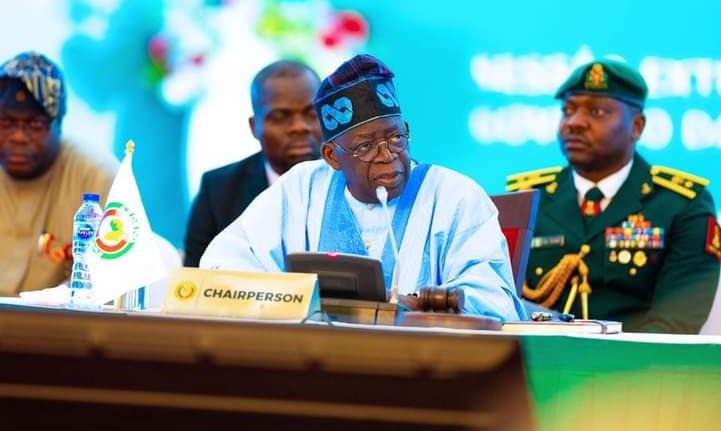
President Bola Ahmed Tinubu has renewed calls for a radical shake-up of the United Nations (UN), insisting that reforms must start with reconstituting the Security Council to grant Africa permanent seats.
He warned that the continent can no longer afford to fill the Council’s agenda from the margins, pointing out that the world of 2026 cannot remain captive to the distribution of power in 1945.
The Nigerian leader made the position in his address delivered by his deputy, Vice President Kashim Shettima, during the General Debate at the ongoing 81st Session of the United Nations General Assembly in New York, United States.
Specifically, he demanded at least two permanent seats for the continent—including full rights, responsibilities, and veto power—along with a total of five non-permanent seats.
“The reform of this institution must begin with the reconstitution of the Security Council, for the world of 2026 cannot remain captive to the distribution of power in 1945. Africa cannot continue to fill the Council’s agenda while remaining absent from its permanent membership.
“Nigeria demands, in accordance with the Ezulwini Consensus and the Sirte Declaration, at least two permanent seats for Africa, with all the rights and responsibilities of permanent membership, including the veto for as long as it exists, and five non-permanent seats in total. The authority to speak for humanity carries an obligation to represent it,” he stated.
President Tinubu also issued a wake-up call to world leaders, demanding an immediate end to global warfare and a total rejection of the rising tide of nationalism.
With urgent moral clarity, he warned that the global order hangs in the balance, while fiercely rallying the international community to dismantle unilateral aggression, resurrect the foundational principles of the United Nations Charter, and forge an unyielding, unified front through a recommitted era of global multilateralism.
The Nigerian leader categorically told the global leaders not to pretend that distant or domestic conflicts do not exact a price from other nations, underscoring the UN’s urgent duty to restore trust in institutions built to reconcile differences and advance global common interests.
“The persistence of conflict across the world recalls the purpose for which the United Nations was founded: to spare succeeding generations the devastation of war. We must therefore return to the founding principles of dialogue, mutual respect and collective responsibility.
“Nigeria stands by the Charter and its promise of a world in which diplomacy prevails over coercion, cooperation over isolation and international law over the arbitrary exercise of power,” he declared.
The President framed Nigeria’s peacekeeping efforts in Africa as a model, noting that the nation stands ready to take on greater responsibility and sacrifice to restore peace across the continent—just as it did in Liberia, Sierra Leone, Darfur, Mali, and The Gambia, where it committed personnel and resources when global solidarity demanded action.
“Through ECOWAS, the African Union and our Gulf of Guinea partnerships, we continue to advance mediation, democratic governance, counter-terrorism and maritime security,” he said, adding that Nigeria’s foreign policy depends on the same conviction that guides its economic reforms.
President Tinubu stated that Nigeria is actioning its sustainable development commitments through disciplined macroeconomic management, robust institutions, private-sector growth, and strategic public investment.
Emphasising that the mission directly links Nigeria’s national advancement to Africa’s progress and a global duty to foster peace, equity, and prosperity, he observed that internal achievements mean nothing if the nation ignores gathering external threats, declaring that geography offers no exemption from the consequences of a fractured world.
Government trust, according to him, is earned only when decisions improve lives, stressing, however, that since no nation is insulated from global conflicts, leaders must face security and climate realities head-on rather than pretending borders offer safety.
The President urged global action on climate change, rejecting the false choice between development and climate action, even as he emphasized that developing countries must industrialize, eradicate poverty, and expand energy access using low-carbon pathways backed by technology transfer and climate finance.
He reaffirmed Nigeria’s commitment to the Paris Agreement and a fair energy transition, stressing that Africa bears a heavy climate burden despite contributing under 4% of global emissions.
Under the Energy Transition Plan, he hinted that the nation is working towards net-zero emissions by 2060 while expanding access to affordable, reliable and sustainable energy.
President Tinubu declared that Nigeria will not let fear dictate its technological future, affirming that AI is a tool driven by human intent, and to harness the tool for human advancement, the nation is aggressively expanding its digital public infrastructure, accelerating broadband deployment, and driving tech entrepreneurship.
He reiterated Nigeria’s call for reform of the international financial architecture, wider access to concessional financing and debt sustainability structure that recognise developmental needs, pointing out that “one of the greatest obstacles to sustainable development is inadequate financing,” as most developing nations spends a good part of their resources on debt servicing at the expense of education, healthcare and infrastructure.
Drawing lessons from Nigeria’s prolonged struggle against Boko Haram, ISWAP and other armed groups, the President said “no nation, however formidable its defences, can secure itself completely against dangers sustained beyond its borders.”
He noted that while modern threats like terrorism and cyberattacks exploit gaps in global action, lasting military victory requires a foundation of education, economic opportunity, accountable governance, and human rights.
As a founding member of ECOWAS, President Tinubu said Nigeria remains ready to uphold regional solidarity and African leadership in resolving security challenges, “reinforced by principled international partnerships.”
The Nigerian leader maintained that Nigeria is committed to the peaceful settlement of disputes under the United Nations Charter, as “the conflicts in Sudan and other war-torn countries demand urgent diplomacy to address their humanitarian, economic and geopolitical consequences.”
“We should all be afraid of a world in which we can no longer tell the victim from the aggressor. When our investment in propaganda shields perpetrators from justice to the point that telling the truth becomes a crime, the promise of this institution stands betrayed,” he stated.
On the expectations from the UN general debate the Nigerian leader noted that “a reformed, inclusive and effective United Nations is indispensable to the peaceful, just and sustainable world that future generations deserve.
“Whatever our differences, we must remember that humanity is our oldest citizenship, and peace is the inheritance we owe every child,” he further stated.