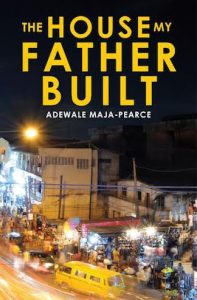
The House My Father Built by Adewale Maja-Pearce; Kachifo Limited (Farafina Kamsi),
Yaba, Lagos, Nigeria; 2014; 175pp
The essayist and critic, Adewale Maja-Pearce, writes in the recently released reprint of his 2014 book, The House My Father Built: “I hadn’t expected anything from my father’s will and was surprised when I discovered that he had left my siblings and me a block of four flats – one each for my mother’s children – in a decent area of Lagos.”
Adewale, son of a Nigerian doctor father and a British mother, had to wait for ten years for the terms of the inheritance to be sorted out before flying in from London where he was living to begin the battle to take hold of the priced property in Surulere, Lagos.
According to Adewale, “Two of the flats, along with the annex at the back, were still occupied
by tenants who had refused my earlier offer of a year rent-free to help them move so I put a
friend in one to keep an eye on things during my prolonged absences and settled into the other as
I prepared to do battle. I had no idea at the time how fierce and long-drawn out it would be, how
rancorous and tiring, how absurd and humiliating.”
The tenants Adewale had to do battle with were ill-assorted: “The most combative – outwardly at
least – was the Yoruba Alhaji in the front flat downstairs, a squat thick-set man in his early fifties
with red lips, bandy legs and a white skull cap. He thought me amusing when I politely knocked
on his door and told him that he had to go in a year’s time, but that it wasn’t personal. In the
event, it took me six years to be rid of him…” Another tenant: “Ngozi, a light-skinned Igbo
woman in her mid-30s, lived with her two brothers, one of whom later turned out to be her son;
the other a scam artist who spent most of his time at one of the many cyber cafes springing up all
over the city.” In Adewale’s words, “Where the Alhaji was mischievous, she was haughty.” Her
eviction is the stuff of Nollywood as narrated in The House My Father Built. The third tenant:
“Pepsi was not only a poor man, but also an ineffectual one, by no means the same thing.” Pepsi
died a year after his eviction, killed by a runaway bus at Ojuelegba.
The real McCoy of the book and house was the unemployed potbellied fellow called Prince who
helped Adewale to facilitate all the evictions while living rent-free. Prince could handle any duty
perfectly except help himself.
Prince could not pay his rent and plotted to indict Adewale by inviting the police only to
paradoxically get himself incarcerated in Ikoyi prison.
Incidentally, Prince had earlier told Adewale that any tenant who sends the police after the owner
of the house “is capable of killing you.” Prince not only called the police on the landlord but
capped it all up by hiring assassins to kill him. He even tried to deploy juju to finish off the
landlord only to confess much later that the landlord survived his diabolical attack because: “You
walk with God.” Prince was fond of saying: “Move by faith and not by sight.”
Prince eventually had to leave the house – and then died.
The House My Father Built by Adewale Maja-Pearce throbs with corrupt policemen, crooked
lawyers and compromised judges in a decadent Lagos society where anything goes.
This book is a creative non-fiction classic as enthralling as V.S. Naipaul’s novel A House for Mr.
Biswas.
Uzor Maxim Uzoatu
The House My Father Built by Adewale Maja-Pearce; Kachifo Limited (Farafina Kamsi),
Yaba, Lagos, Nigeria; 2014; 175pp
The essayist and critic, Adewale Maja-Pearce, writes in the recently released reprint of his 2014
book, The House My Father Built: “I hadn’t expected anything from my father’s will and was
surprised when I discovered that he had left my siblings and me a block of four flats – one each
for my mother’s children – in a decent area of Lagos.”
Adewale, son of a Nigerian doctor father and a British mother, had to wait for ten years for the
terms of the inheritance to be sorted out before flying in from London where he was living to
begin the battle to take hold of the priced property in Surulere, Lagos.
According to Adewale, “Two of the flats, along with the annex at the back, were still occupied
by tenants who had refused my earlier offer of a year rent-free to help them move so I put a
friend in one to keep an eye on things during my prolonged absences and settled into the other as
I prepared to do battle. I had no idea at the time how fierce and long-drawn out it would be, how
rancorous and tiring, how absurd and humiliating.”
The tenants Adewale had to do battle with were ill-assorted: “The most combative – outwardly at
least – was the Yoruba Alhaji in the front flat downstairs, a squat thick-set man in his early fifties
with red lips, bandy legs and a white skull cap. He thought me amusing when I politely knocked
on his door and told him that he had to go in a year’s time, but that it wasn’t personal. In the
event, it took me six years to be rid of him…” Another tenant: “Ngozi, a light-skinned Igbo
woman in her mid-30s, lived with her two brothers, one of whom later turned out to be her son;
the other a scam artist who spent most of his time at one of the many cyber cafes springing up all
over the city.” In Adewale’s words, “Where the Alhaji was mischievous, she was haughty.” Her
eviction is the stuff of Nollywood as narrated in The House My Father Built. The third tenant:
“Pepsi was not only a poor man, but also an ineffectual one, by no means the same thing.” Pepsi
died a year after his eviction, killed by a runaway bus at Ojuelegba.
The real McCoy of the book and house was the unemployed potbellied fellow called Prince who
helped Adewale to facilitate all the evictions while living rent-free. Prince could handle any duty
perfectly except help himself.
Prince could not pay his rent and plotted to indict Adewale by inviting the police only to
paradoxically get himself incarcerated in Ikoyi prison.
Incidentally, Prince had earlier told Adewale that any tenant who sends the police after the owner
of the house “is capable of killing you.” Prince not only called the police on the landlord but
capped it all up by hiring assassins to kill him. He even tried to deploy juju to finish off the
landlord only to confess much later that the landlord survived his diabolical attack because: “You
walk with God.” Prince was fond of saying: “Move by faith and not by sight.”
Prince eventually had to leave the house – and then died.
The House My Father Built by Adewale Maja-Pearce throbs with corrupt policemen, crooked
lawyers and compromised judges in a decadent Lagos society where anything goes.
This book is a creative non-fiction classic as enthralling as V.S. Naipaul’s novel A House for Mr.
Biswas.