

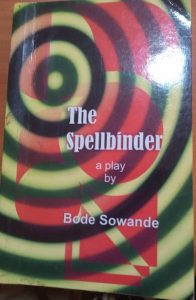
Title: Spellbinder
Author: Bode Sowande
Date of Publication: 2021
Publisher: Crafted and Bound Wordworks, Ibadan
Reviewer : Alvan Ewuzie
Renowned playwright and Director, Bode Sowande’s latest offering is a clear indication that, as the saying goes, wine gets better with age. In thematic concern, acting skill challenges, directorial creativity, and virtually every aspect of stage production, Bode Sowande’s new work titled Spell Binder stretches the skills of any actor and director.
The thematic concern, which is a foray into psychosis, is not a regular consideration for many a playwright. The several flash backs, resulting in differing age range for some characters, are not regular tasks for directors and actors. The Spellbinder is a consummation of Sowande’s years of experience as playwright and Director. He has been at it for nearly five decades, which is why the script ranks very high in language, characterization, setting, thematic concern and production challenges.
In the play, Sowande delves into a scarcely attended aspect of life. People suffer psychosis but would not admit same because their psyche has turned their experiences to imaginary delusions that refuse to go away. Such people live in their thoughts. Some mental health challenges come from the human thoughts, not any real problems, which is why only the concerned person lives in the world of his thoughts. People are driven by their thoughts, yet the body pretends to be in control.
‘In this life, only God knows. He has the total picture’ , a line rendered by one of the characters tends to capture the apparent mystery in the deep psychological state of human beings. No one can be sure of the mental state of others. Sowande weaves the story around a rather complex plots and sub plots that kept unfolding like layers of onions.
Adamu, one of the major characters in the play, suffers a rather heart wrenching experience when his friend slept with his wife and had a baby. The situation drove him into psychosis, a mental state that made a psychiatric patient for thirty years. The plot is not as simple as the foregoing, but the intricacies of multiple plot and subplots show that the taste of the pudding is unmasked at the eating. The several flash backs that show some characters at different ages and stages of their lives constitute some of the challenges confronting actors and Directors who would bring the story to life.
Adamu, whose wife caved in to the advances of his friend, fall into depression which his head and brain turn into a spell binder, from which his deep pocket could not free him, such that his physiatrist passes away and bequeaths him as a patient to his daughter who is also a psychiatrist. The spell binder kept its unending visit, in spite of his mouthwatering financial offer to the Doctor if she could keep the spell binder away. He had been shocked into celibacy after the incident of infidelity that ruined his marriage. The situation, which lasted for 30 years, compounded his psychotic condition.
Sowande’s handling of dialogue and the psyche of the characters is novel, and an indication that his research on the matter was deep. The characters, in the course of their normal life, are clear indications that ‘only God knows’ people with mental problems.
The foregoing is in tandem with the recent comments of Bamidele Owoyele, Professor of Physiology and President of Illorin Neuroscience Group affirming that a quarter of Nigerians have varied forms of mental challenges.
Adamu typifies one of those Nigerians whose mental challenge may be a creation of his mind, a reaction to an event that has created the spellbinder in his head. The resolution which came through assurances that his head was playing a trick on him shows that the mind rules the body.
Sowande’s new offering had been staged as directed by him. It was the convocation play in 2019 at Ajayi Crowther University, where he heads the Department of Performing Arts and Music. That stage performance may have influenced the change in the play’s title from Lanke’s Quest to the more fitting one with which it was published by Craft and Bound Wordworks in Ibadan. Sowade, directed the play, and probably saw where it needed to be amended. Sowande’s long experience as a playwright and Director came to the fore in the work. The task for a reader to follow the layers of flash backs could stand both as a plus and minus for the work.
But Sowande’s foray into the unknown can only be so masterfully done by a confident playwright who knows his onions.
