From Victor Osula Abuja
President Bola Tinubu has urged Nigerian journalists to match press freedom with professionalism, accuracy, and ethical responsibility, warning that misinformation, fake news, and emerging technologies such as deepfakes pose serious threats to democracy and national security.
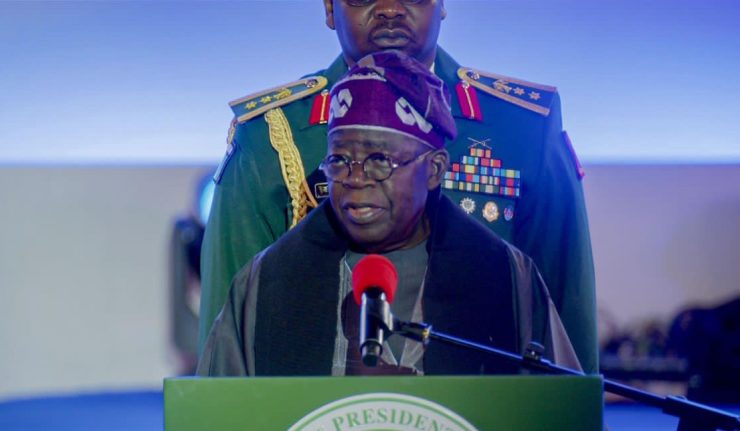
Speaking at the maiden State House Press Corps Presidential Dinner in Abuja on Thursday, the President reaffirmed his administration’s commitment to protecting press freedom and freedom of expression, stressing that while a free press remains indispensable to democracy, its rights must always be exercised with responsibility.
Tinubu described the media as an indispensable pillar of democracy and a vital partner in Nigeria’s development.
Addressing State House Correspondents, he apologised for the delay in organising the event, attributing it to the demands of governance and constantly changing official schedules.
“I appreciate all of you here for your tireless efforts in covering the State House. I appreciate your dedication to ensuring Nigerians are informed about my government’s activities,” he said.
The President assured members of the State House Press Corps that his administration would continue to guarantee journalists access, resources, and the constitutional freedom required to perform their duties effectively.
Declaring himself “an apostle of a free press,” Tinubu said he had consistently defended media rights throughout his political career and would continue to do so, while stressing that freedom must always be exercised responsibly.
Democracy rests on the pillars of freedoms: freedom of speech, freedom of the press, freedom of association, and others. I am an apostle of a free press. I have defended and advocated for the rights of the media throughout my public life and will continue to do so.”
He, however, emphasised that journalism carries significant responsibility, noting that democracy cannot thrive without a free and accountable press.
“Democracy is stymied without a free press. The fourth estate must be free, and not a fief. However, where there is enormous power, there should be accountability and responsibility. The ethics of the profession must be considered sacred and upheld by practitioners,” he added.
The President expressed concern over the increasing spread of misinformation, disinformation, fake news, voice and facial cloning, as well as deepfake technology, describing them as major challenges confronting modern journalism.
According to him, media practitioners must avoid becoming channels for falsehood and unverified information capable of undermining national security.
“We live in an era where misinformation and disinformation travel faster than facts. The media must choose fact over falsehood, substance over sensation, and credibility over clickbait and the endless race for followers, likes, and viral outrage,” Tinubu said.
He noted that although government and the media often appear to be adversaries in a democratic environment, both institutions ultimately share the responsibility of serving the Nigerian people.
“We are adversaries only in the democratic sense. Government exists to serve the people through leadership, policy, and public service. The media exists to serve society by watching those entrusted with power, asking difficult questions, and holding government accountable,” he explained.
Reflecting on his more than three decades in public life, Tinubu recalled being one of Nigeria’s most scrutinised political figures and criticised the tendency of some media reports to elevate rumours and allegations into accepted facts.
He cited contrasting newspaper headlines about the economy to illustrate the importance of context, analysis, and balanced reporting.
“What fascinated me was how quickly speculation could become accepted wisdom, how allegations could become headlines, and how often conclusions arrived long before the facts,” he said.
According to the President, democracy ultimately allows citizens to distinguish facts from fiction, reinforcing the need for responsible journalism.
Tinubu stressed that freedom of expression should never be interpreted as freedom to defame or deliberately mislead the public.
“Rights come with responsibilities. Public trust is earned through fairness, professionalism, accuracy, and integrity,” he said.
He also defended existing laws, including the Cybercrimes Act and other relevant legislation, saying they were designed to protect citizens against malicious falsehoods, cyberstalking, identity theft, and other digital crimes rather than weaken press freedom.
Reaffirming his administration’s commitment to constitutional guarantees, Tinubu cited Sections 22 and 39 of the 1999 Constitution, saying they remain the foundation for media freedom and government accountability in Nigeria.
He also highlighted the importance of the Freedom of Information Act in promoting transparency, openness, and citizens’ access to information.
The President used the occasion to defend his administration’s economic reforms, saying the difficult but necessary policy measures introduced since assuming office were beginning to yield positive results.
He said Nigeria’s economy is stabilising, public revenues have strengthened significantly, investor confidence is returning, foreign reserves have improved considerably and renewed investments are flowing into the oil and gas sector.
Tinubu added that tax reforms, fiscal adjustments, infrastructure investments, and improvements in the business environment are laying the foundation for a more competitive and prosperous economy.
On security, the President said his administration had intensified military operations across several theatres, improved intelligence gathering, strengthened inter-agency collaboration, and expanded regional cooperation.
He noted that thousands of terrorists and criminal elements had been neutralised, hostages rescued and communities reclaimed, while security agencies continued to confront terrorism, banditry, kidnapping, oil theft and other crimes.
While acknowledging that security challenges remain, Tinubu maintained that the country has steadily moved from merely reacting to threats to systematically degrading criminal networks.
Describing the media as one of the strongest pillars of democracy, Tinubu said journalism plays a critical role not only in holding government accountable but also in informing citizens, promoting civic participation, strengthening national cohesion, and supporting economic development.
He called for stronger collaboration between the government and the media based on mutual respect, professionalism, and a shared commitment to national progress.
“Let us replace needless hostility with constructive engagement. Let us replace sensationalism with professionalism. Let us replace the pursuit of outrage with the pursuit of truth.
“Together, let us continue building a nation where truth matters, accountability thrives, democracy flourishes and every Nigerian has reason to believe in the promise of our country,” he said.
The President thanked members of the State House Press Corps for their dedication and contributions to Nigeria’s democracy, expressing hope that the presidential dinner would become an enduring tradition that strengthens relations between the Presidency and the media.