By Ayo Kehinde
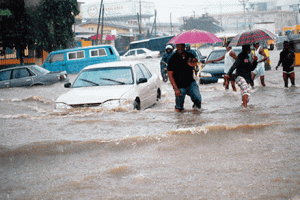
The Lagos State Ministry of Environment and Water Resources has warned residents, motorists, and airline operators to prepare for heavy rainfall, flooding, and strong winds as the 2026 rainy season begins.
Commissioner for Environment, Tokunbo Wahab, made the announcement during a press briefing at the Ministry’s headquarters in Lagos.
He urged residents to comply with environmental regulations, take precautionary measures, and remain vigilant in flood-prone areas, while motorists and businesses are advised to anticipate disruptions caused by storms.
Wahab said the forecasts were based on the February 10, 2026 report by the Nigerian Meteorological Agency (NiMet), which projected rainfall patterns, temperature changes, and other weather parameters across the country.
According to him, the state conducts annual briefings to ensure residents and businesses are adequately prepared for expected weather impacts.
The commissioner explained that the 2026 rainy season is influenced by a weak La Niña and a neutral phase of the El Niño Southern Oscillation (ENSO).
“This suggests an early onset, longer duration, and delayed end of the rainy season in Lagos, with above-normal rainfall expected during the first peak,” Wahab said.
He provided projections for key areas in the state. Rainfall in Ikeja is expected from March 31 to December 2, totaling 1,932 mm, while Badagry is projected to receive rainfall from March 28 to December 3, totaling about 2,010 mm.
Ikorodu is forecasted to have rainfall from March 31 to December 2, with approximately 1,935 mm, Lagos Island from March 30 to December 2, totaling 1,968 mm, and Epe from March 29 to December 3, with about 1,984 mm.
The average annual rainfall across Lagos’ 20 Local Government Areas is estimated at 1,965 mm, with Lagos and neighboring Ogun State likely to experience above-normal precipitation.
Wahab warned that heavy rains could trigger flooding in low-lying communities, while strong winds at the onset and end of the rainy season could pose risks to life and property. Thunderstorms and heavy rainfall may also disrupt commercial activities, traffic flow, and flight schedules.
To strengthen preparedness, the state government has enhanced its monitoring systems through weather and river gauge stations, intensified flood control measures, and maintained close collaboration with the Ogun-Oshun River Basin Development Authority to regulate water releases from the Oyan Dam. Low-lying communities such as Agiliti, Agboyi, Itowolo, and Ajegunle are being closely monitored due to flooding risks.
The commissioner appealed to residents to avoid indiscriminate dumping of refuse and construction on drainage channels, noting that such practices worsen flooding.
Citizens living along flood plains in areas like Owode, Iwaya, Makoko, Badia, Ijora, Isaalu, Pota, and Shibiri were advised to remain vigilant and relocate to safer areas if necessary.
Motorists were cautioned to observe speed limits during heavy rainfall, while residents were urged to regularly clear drains around their homes to support government flood prevention efforts.
“By following these guidelines and remaining alert, residents, motorists, and businesses can reduce the risks posed by the rainy season and protect both life and property,” Wahab cautioned.