

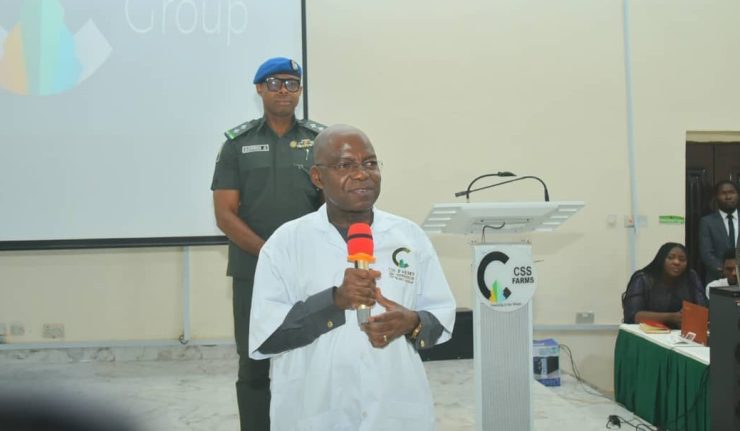
By Ayo Kehinde
Abia State has emerged as Nigeria’s highest-rated state for citizen satisfaction and one of the country’s fastest-improving governments, according to the 2026 Nigeria State Performance Index (pSPI) released by Phillips Consulting. Notably, oil rich Lagos, Delta, Rivers and industrial complex- supported Ogun state are missing from the rating.
The report, published by StatiSense in collaboration with Philips Consulting, assessed the performance of Nigeria’s 36 states and the Federal Capital Territory using 37 governance indicators, combining 70 per cent objective data from audited financial statements and other credible official records with 30 per cent citizen perception gathered through a nationwide survey.
The methodology assessed governance across fiscal management, infrastructure, healthcare, education, social development, economic management and public service delivery to determine whether states are effectively converting public resources into improved living conditions for residents.
Abia also emerged as the third most improved state in Nigeria on the pSPI Momentum Index, recording +0.67, behind Enugu (+1.15) and Jigawa (+0.77), reflecting the pace of governance reforms implemented in recent years.
Phillips Consulting said Abia’s impressive rise reflects a “service-delivery turnaround,” where prudent financial management has translated into tangible improvements that citizens can directly experience.
Governor Alex Otti joins officials and passengers aboard one of the new Abia Green Shuttle electric buses.
According to the report, the state’s performance was driven by improved fiscal management, significant debt reduction, expanding healthcare reforms, free basic education, and visible infrastructure renewal, all of which have generated what it described as “exceptionally strong citizen confidence across multiple sectors.”
Beyond its overall ranking, Abia dominated several citizen-rated governance indicators.
Residents awarded the state 4.33 points for publicity of government policies and another 4.33 for government support to businesses—the highest score nationally in both categories, with the business support rating tied only with Cross River State.
Abia also recorded the country’s highest ratings for security (4.08), public transportation (4.25) and healthcare affordability (4.00).
The state equally shared the national top position on ease of property ownership with Adamawa and Nasarawa, with each recording 4.00 points.
Road infrastructure also received widespread public approval, with Abia scoring 4.42, second only to Gombe’s 4.50, while environmental cleanliness attracted 4.08, narrowly behind Gombe’s 4.10.
The report further ranked Abia second nationwide in education quality and economic opportunity after the state scored 3.58 in both indicators.
Despite the impressive ratings, the report showed that employment creation, access to clean water and law-enforcement conduct remain areas where residents expect greater improvements.
Abia recorded 3.08 for employment opportunities, 3.17 for access to potable water and 3.42 for law-enforcement conduct. However, all three indicators remained above the national averages.
Across Nigeria, employment posted the country’s lowest citizen satisfaction score at 2.42, followed by access to clean water at 2.52, while law-enforcement conduct recorded 2.53, making them the nation’s most persistent governance concerns.
The report attributed much of Abia’s success to sustained fiscal reforms and prudent financial management.
According to the assessment, the state generated internally generated revenue equivalent to 55 per cent of its Federation Account Allocation Committee (FAAC) allocation, achieved an IGR per capita of N8,918, maintained a 68 per cent capital investment ratio, and reduced its debt burden to N35,474 per resident.
Among the flagship programmes highlighted was the state’s free basic education initiative, which has benefited more than 300,000 pupils, alongside the recruitment of 5,294 teachers to strengthen public education.
Phillips Consulting identified debt reduction, stronger fiscal governance and sustained investments in education and healthcare as the principal drivers behind Abia’s rapid rise in the national rankings.
The report also named the South-East as Nigeria’s best-performing geopolitical zone on the Momentum Index, recording an average score of +0.12, largely driven by the performances of Enugu and Abia.
It noted that Enugu now generates 218 per cent of its federal allocation internally, while Abia has successfully transformed governance reforms into exceptionally high levels of public confidence.
Rejecting the notion that natural resource wealth determines governance outcomes, the report concluded that deliberate leadership and efficient public administration now distinguish Nigeria’s top-performing states.
“The pattern is not north-versus-south but governance-versus-endowment,” the report stated.
It added that while the South-East now leads on the strength of Enugu and Abia, the North-West and North-East are recording significant progress through fiscal discipline and social-sector investments. By contrast, some resource-rich states in the South-South and parts of the North-Central have experienced declining momentum.
The report further revealed that Nigeria’s highest-performing states reached their positions through different governance strategies.
Enugu topped the Momentum Index through aggressive internally generated revenue reforms that pushed its earnings to 218 per cent of its federal allocation.
Jigawa combined prudent fiscal management with the country’s lowest debt burden at N5,057 per citizen, while Lagos remained Nigeria’s fiscal powerhouse by generating about 369 per cent of its FAAC allocation internally, becoming the first state to exceed N1 trillion in internally generated revenue.
Kano also demonstrated strong fiscal independence by generating 127 per cent of its federal allocation internally.
However, Phillips Consulting stressed that financial strength alone does not guarantee better governance outcomes.
“The states that top this index are not the richest,” the report noted. “Several are modestly resourced northern states, while some resource-rich states sit near the bottom. The lesson, repeated across indicators and states, is that governance and service delivery—not the size of the purse—determine what citizens actually experience.”
The Nigeria State Performance Index (pSPI) is an annual governance assessment by Phillips Consulting that measures how effectively Nigeria’s 36 states and the Federal Capital Territory translate public resources into measurable development outcomes.
The index combines audited financial data with nationwide citizen perception surveys, providing an independent benchmark of governance performance across fiscal management, infrastructure, healthcare, education, public service delivery, and institutional effectiveness.
The 2026 report comes at a time when state governments are under increasing public scrutiny over how
