

The cracks in the League of Nations, which was established in 1919 for the promotion of international co-operation, peace and security came rather too early. The break-up of the League resulted from her inability to settle major disputes that were addressed to her. Hence, as these disputes escalated, the very foundation of the League which was the willingness or agreement of the big powers to act together was eroded to a point where the League became only a paper-tiger.
This deteriorating trend that culminated in the Second World War and the subsequent cessation of the League’s existence started with the Sino-Japanese dispute. After the Japanese invasion of Manchuria in 1931, the League made frantic efforts to stop the war. She set up a Commission of Inquiry which came up with recommendations for normalization of relations between the two powers. Unfortunately, as history books tell us, the Japanese Government turned down the proposal and withdrew from the League. The war raged on with the world watching helplessly.
Soon after, the Italians invaded Abyssinia in total defiance of the League’s pleas, recommendations and injunctions. Even the application of the League’s laid down sanction of ostracism against such erring states, and to which about fifty member-states ratified, failed to deter Italy’s aggression against Abyssinia. Eventually, Italy over-ran Abyssinia and like the Japanese, withdrew her membership of the League.
The final blow that was to signal the total collapse of the League did not take long in coming. When it did come; the Second World War not only marked the demise of the League but also exposed the inherent structural weakness of the organisation.
We are at it again! Even the United Nations Organisation, which replaced the League of Nations is more or less a carbon copy of the defunct League of Nations notwithstanding the observed shortcomings of the latter. The rising global tensions in the world today has just led Russia, China and Iran to sign a pact for unified response to fight the US if it attacks any of them.
Given the rising disputes, tensions and unwarranted aggression around the world today, and the looming World War they portend, we need to revamp the United Nations (UN) and give it the sure-footing to douse such escalations, if we genuinely wish to avoid a third World War.
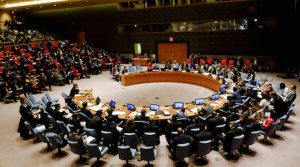
Presently, the UN lacks the capacity to stem the tide in these two critical and pivotal theatres – the Russo-Ukraine war and the Israeli-Palestinian/Iranian conflicts – while the simmering China-Taiwan imbroglio appears completely beyond UN intervention or management! Discussions of the above conflicts within the United Nations Security Council (UNSC) often end up in stalemates due mainly to the perpetual disagreement and squabbles amongst its permanent members or the big-five, who readily flash their respective veto-cards to annul virtual decisions of the council from time to time. The result is that the UNSC is increasingly becoming ineffective, irrelevant and, I dare say, an obstacle to progress.
The structure of the UN and the use of veto-power are the main reasons why the UN is under-performing! Increasing the number of permanent members of the UNSC, as is being suggested in some quarters, will worsen matters by increasing the chances of effective annulment of every decision in the council.
Meanwhile, the emergent US-Venezuela faceoff and surprising US overtures to acquire or annex Greenland are widening in scope. The way things are going, it may not take long to see Russia and USA withdraw their respective memberships of the United Nations in much the same way Japan and Italy dropped their respective memberships of the League of Nations. Of course, the US is already half way there, given its announced withdrawal from 31 UN agencies recently! Indeed, if I may ask: has the United Nations not become a paper-tiger like the League of Nations just before its eventual collapse?
The problem is that the subsisting arrangement denies the UN the democratic pull and appeal that should have conferred the requisite leverage or de facto leadership on her. Rather, the arrangement promotes autocracy and quasi-colonisation of the rest of the world by the big-five.
This is detrimental to progress, because the environment is poisoned by largescale political exclusion. Therefore, for the UN to thrive, it must be democratised, with full legislative powers and function residing with a new UN Assembly or World Assembly, which would displace both the UN General Assembly (UNGA) and the UNSC, and such that every member-nation can partake in the law-making/decision-taking processes of the UN. No veto-power!
This will underscore the march of democracy, which would empower the UN to hold every-nation in check. Indeed, a restructured UNSC should become the in-house committee on security for a new UN or World Assembly. Membership of the committee should consist of the first ten most powerful member-nations, with another ten elected members.
Secondly, power-sharing amongst UN member-nations should be predicated on the national power of each nation, which is a three-dimensional concept resting on the following three axions: (1) population; (2) equality of states principle (that derives from national character); and (3) economic power (reckoned from their respective GDPs).
Call it ‘the democracy of the third degree’, if you like! The three factors are to be used in determining the respective voting power or number of parliamentary seats assignable to each member-nation, as detailed in my new book, Towards Effective World Security.
Decisions in the new Assembly are to be made on democratic principles and as reflected by votes obtained on the floor of the Assembly. It is possible that decisions on procedural matters will be based on the simple majority rule while the more difficult matters like compelling a nation on any issue – e.g., to back-down in a quarrel with another nation, ostracism, etc. – may require the securing of absolute majority of votes on the floor of the UN or World Assembly.
The UN was established shortly after the Second World War in 1945 by the major victorious powers in that war, namely: USA, USSR (now Russia), UK, France and China. They imbued the UNSC with certain powers and roles that ought to belong to the legislative arm of the UN, the so-called General Assembly, thereby making it an inferior legislature of the colonial type.
The big-five became the only permanent members of the Council, with domineering powers and colonising influences in world affairs! The UNSC became the podium from which the big-five hoped to continually survey the world scene and deal with any recalcitrant nations, to keep the world peaceful.
But this mindset was borne out of a wrong analysis of the problem, for the real threat to world peace lay elsewhere. However, with the situation in Ukraine and Venezuela today (amidst US threat to annex Greenland), and a looming Third World War to boot, it is becoming clearer that it is only the big powers that can threaten world peace, for the Ukraine war is, in reality, a war between NATO or European powers and Russia – a war that underscores the inadequacy of the UN as presently structured.
Accordingly, for the UN to keep the world away from another major war as well as save the big powers from themselves, it must have leverage over and above every nation, big or small, as suggested above. The bottom-line is that the present upheavals going on in the world will either end in a terrible conflict or produce a drastic revolution that will enthrone a new acceptable method of managing our world as well as improve how extra-heterogenous country-states like Nigeria fare.
uchennwankwo@gmail.com
