


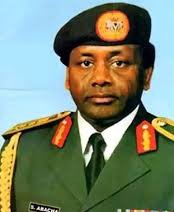
Retired Department of State Services DSS, Chief, Dennis Amachree, has offered what he describes as the most authoritative account yet of the death of Nigeria’s former military Head of State, General Sani Abacha, claiming the late ruler died during an intimate encounter in the early hours of June 8, 1998, and not from poisoning or any international conspiracy.
Amachree, a former Assistant Director of Operations and Intelligence at the then State Security Service (SSS), made the revelation in his newly released 348-page memoir, ‘DSS @40: My Journey Behind the Shield’, excerpt of which was published in The Nation. In it, the spy chief chronicles his career in Nigeria’s intelligence community and recounts his role in the investigation that followed Abacha’s sudden death.
The retired intelligence officer said his account is based on firsthand operational knowledge, insisting it finally settles nearly three decades of speculation over the circumstances surrounding the military ruler’s demise.
According to him, the woman who was with Abacha at the time of his death immediately denied any wrongdoing when she was later arrested and questioned by the SSS.
“The first thing she said to me was: ‘I did not kill him, he died on top of me’,” Amachree wrote, recalling the interrogation he personally conducted.
He maintained that the pharmacist’s account “remains the true position” and effectively lays to rest the numerous conspiracy theories that have persisted since June 1998.
In Chapter 17 of the memoir, titled The Months of Death: A Turning Point in Nigerian History, Amachree reconstructed what he described as Abacha’s final hours.
He claimed that shortly after former Minister of the Federal Capital Territory, General Jeremiah Useni, departed the Presidential Guest House at Aso Rock, Abacha received a female companion who arrived with her younger sister, identified only as a pharmacist attending a conference in Abuja.
According to the account, Abacha had recently purchased a sport utility vehicle for the elder sister. After spending some time at the Guest House, she reportedly returned to the Nicon Noga Hilton Hotel, leaving her younger sister alone with the Head of State.
Amachree alleged that at about 4:05 a.m., while they were engaged in an intimate encounter, the pharmacist noticed Abacha had suddenly become motionless.
After checking his pulse and discovering he was unresponsive, she reportedly panicked, dressed quickly and requested transportation back to her hotel without informing soldiers on duty that the Head of State had collapsed.
She and her sister subsequently travelled to the Abuja airport, where the pharmacist boarded a 7:00 a.m. Okada Air flight to Lagos.
The retired DSS officer described that period as the critical gap missing from previous public accounts of Abacha’s death.
Amachree said he received a telephone call from the Director of Operations at the SSS National Headquarters on the morning following Abacha’s death, directing him to locate and arrest the pharmacist in Lagos.
According to him, operatives traced her to an address in Ogudu and brought her to his office for questioning.
He said the woman immediately volunteered the statement that has become the centrepiece of his account.
Amachree said that after taking her statement, he contacted SSS headquarters in Abuja, following which she was flown back to the Federal Capital Territory.
He insisted that her testimony represented the authentic account of Abacha’s final moments.
A major theme of the memoir is Amachree’s rejection of several narratives that have shaped public discourse on Abacha’s death.
He dismissed allegations that the late Head of State died after eating a poisoned apple allegedly supplied by dissident military officers.
He also rejected claims that Abacha was poisoned through a handshake with a member of Palestinian leader Yasser Arafat’s delegation.
Similarly, he disputed allegations that foreign intelligence agencies, particularly the United States Central Intelligence Agency (CIA), orchestrated the military ruler’s death.
According to him, sensational accounts involving imported Indian prostitutes, poisoned fruit and international espionage flourished because those with knowledge of the actual events deliberately withheld critical information.
“The lady pharmacist’s account, on whom Abacha apparently had a coitus-induced cardiac arrest, remains the true position and puts an end to the conspiracy theories and half-truths that have gone viral”, he wrote.
The retired intelligence officer also challenged accounts previously advanced by several prominent figures.
Among those whose narratives he questioned were former Chief Security Officer to Abacha, Major Hamza Al-Mustapha; former FCT Minister, General Jeremiah Useni; former military physician, Brigadier-General Oviemo Ovadje; former United States National Security Adviser, Susan Rice; The Irish Times journalist David Orr; and former Aviation Minister, Femi Fani-Kayode.
According to Amachree, while those accounts attracted considerable public attention, none satisfactorily explained the events that transpired during what he described as the “missing one-and-a-half-hour window” before security officials discovered Abacha had died.
He argued that the omission created fertile ground for conspiracy theories that have endured for decades.
Beyond the circumstances of Abacha’s death, the memoir revisits the legacy of his administration, describing it as a period marked by authoritarian rule, widespread human rights abuses, arbitrary arrests, torture and extrajudicial killings.
Amachree noted that Abacha died barely one month before the death in detention of Chief Moshood Kashimawo Olawale (MKO) Abiola, widely believed to have won the annulled June 12, 1993 presidential election.
He also disclosed that before his sudden death, Abacha had concluded plans to transform himself from military ruler into an elected civilian president.
According to the author, the five political parties created under the transition programme all adopted Abacha as their presidential candidate, giving rise to the late Chief Bola Ige’s famous description of them as “the five fingers of a leprous hand.”
Amachree argued that Abacha’s death abruptly ended the succession project and fundamentally changed the course of Nigeria’s democratic transition.
Reflecting on the broader significance of the episode, the retired DSS officer said Abacha’s death demonstrated that political power is ultimately transient.
He questioned why senior military officers, close associates and politicians allegedly promoted conflicting narratives about the military ruler’s death, insisting that history must be anchored on verifiable facts rather than speculation.
“While the truth may be suppressed temporarily, the forces of human curiosity and investigative inquiry will ultimately bring it to light”, he wrote
