

By Ayo Kehinde
African leaders have endorsed the establishment of the African Credit Rating Agency to address biases in global credit ratings that have long hindered the continent’s economic growth.
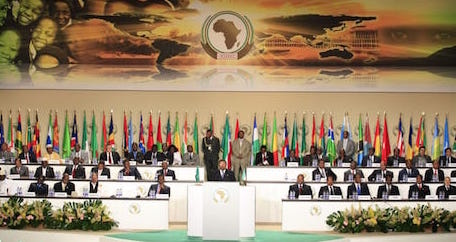
The decision was reached on Thursday during the 38th Ordinary Session of the Assembly of the African Union Heads of State and Government in Addis Ababa, Ethiopia.
Nigeria’s President, Bola Tinubu, arrived in Addis Ababa on Thursday night to participate in the summit.
During a high-level dialogue, African leaders argued that existing global credit rating agencies have unfairly downgraded African economies, making it more difficult for countries to access affordable financing.
According to the African Peer Review Mechanism and the United Nations Development Programme, Africa loses an estimated $75 billion annually due to biased credit ratings.
Kenyan President William Ruto, who is championing the AfCRA initiative, decried the systemic downgrades affecting African nations despite their vast natural resources, strong diaspora remittances, and economic potential.
“In the past decade, 94 percent of downgrades have targeted African economies, with only two countries on the continent attaining investment-grade ratings,” Ruto stated.
He added that an improvement of just one level in Africa’s credit rating could unlock $15.5 billion in additional funding, far exceeding Official Development Assistance by 12 percent and covering 80 percent of Africa’s infrastructure needs.
“This opportunity is within our grasp, and we must seize it,” Ruto told the gathering of African heads of state and financial experts.
Other speakers at the summit included Algerian President Abdelmadjid Tebboune, Chairperson of the Africa Peer Review Forum of Heads of State and Government; Ethiopian President Taye Selassie; Zambian President Hakainde Hichilema; and African Union Commission Deputy Chairperson Monique Nsanzabaganwa.
AfCRA, which is expected to be officially launched in June, aims to provide fair, transparent, and development-focused credit ratings tailored to the realities of African economies.
The initiative seeks to reduce Africa’s reliance on the three dominant global credit rating agencies—Moody’s, Fitch, and Standard & Poor’s—whose assessments have often been criticized for failing to account for the continent’s economic diversity and potential.
Ruto argued that Africa’s economic story has been distorted for too long, adding that the new agency would help reclaim the continent’s financial sovereignty.
“The time has come to rewrite our history, reclaim our narrative, and drive Africa’s economic renaissance forward,” he said.
He accused global rating agencies of using outdated models, flawed assumptions, and systemic bias, which have led to exaggerated risk assessments, inflated borrowing costs, and deterred foreign investment.
He said, “This financial straitjacket imposed on Africa punishes our economies while rewarding others with comparable or even weaker fundamentals.
“African nations deserve an independent, credible, and globally recognized rating agency that reflects our reality. AfCRA must be backed by strong data, rigorous reporting standards, and full transparency from our own governments.”
The agency, leaders said, will help African economies attract fairer investment terms and build resilience against external financial shocks.
