Hundreds of protesters demanding tougher action against undocumented immigration marched through Johannesburg on Wednesday, forcing businesses to shut down in parts of the city’s Central Business District and reigniting concerns over rising anti-foreigner sentiment in South Africa.
The protest, organised by the anti-illegal immigration movement, March and March, drew supporters from Operation Dudula, ActionSA, the Inkatha Freedom Party (IFP) and the uMkhonto weSizwe (MK) Party.
Demonstrators gathered at Mary Fitzgerald Square in Newtown before marching under heavy police and metro police escort to the Gauteng Provincial Legislature, where they submitted a memorandum demanding stricter immigration enforcement, tighter border controls and the deportation of undocumented migrants.
According to agency reports, tension escalated in parts of Johannesburg’s CBD as some protesters reportedly ordered foreign shop owners to close their businesses. Several shops shut down amid fears of intimidation and possible attacks.
The demonstration reflected growing public frustration over crime, unemployment and economic hardship, issues protest organisers linked to undocumented migration and weak border enforcement.
Addressing supporters outside the legislature, March and March leader, Jacinta Ngobese Zuma, said the movement wanted the government to deport all undocumented foreign nationals and strengthen oversight of immigration documentation.
“We want every person who enters South Africa to have their documentation reviewed and for those found to be in the country illegally to be deported to their country of origin”, she said.
Ngobese Zuma also accused corrupt police officers and officials of enabling illegal migration.
“We want police officers who have integrity. If your seniors are working with illegal foreigners, they must also be arrested”, she said.
The protesters’ memorandum called for tighter visa regulations, reforms to asylum policies, sanctions against businesses employing undocumented migrants and restrictions on services for illegal immigrants.
ActionSA leader, Herman Mashaba, who joined the protest, said the government had failed for years to address illegal immigration and border security.
“We want the government to send all illegal foreigners back to their countries. We have got enough of our own problems”, Mashaba said.
He warned that government inaction could worsen public anger and insecurity.
Mashaba referenced the disappearance of 27-year-old Mazwi Khubheka from Vosloorus, alleging that criminal syndicates involving foreign nationals were contributing to rising insecurity.
The protesters handed their memorandum to Gauteng Premier, Panyaza Lesufi, who promised that the provincial government would respond within seven days.
However, sections of the crowd booed the premier as he departed shortly after receiving the document.
The Johannesburg protest comes amid similar anti-illegal immigration demonstrations in parts of KwaZulu-Natal and the Eastern Cape, signalling growing national pressure on the South African government over migration and border management.
In a statement issued after the protest, government spokesperson William Baloyi said authorities were intensifying efforts to tackle illegal immigration through tighter border controls and immigration reforms.
“Government is strengthening measures to address illegal immigration, including tightening border controls to combat unlawful entry, illicit trade and fraudulent activities that undermine revenue collection and the rule of law”, Baloyi said.
According to him, reforms include the introduction of an Electronic Travel Authorisation system and upgrades at major border posts, including Lebombo, Beitbridge, Oshoek, Kopfontein, Maseru Bridge and Ficksburg.
Baloyi said deportations had increased by 46 percent, adding that the Border Management Authority had deported about 500,000 undocumented migrants since April 2023. He also disclosed plans to recruit 10,000 additional labour inspectors to strengthen enforcement against illegal employment practices.
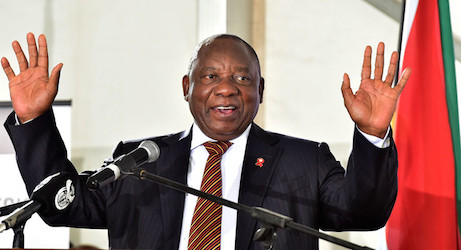
President Cyril Ramaphosa had earlier cautioned against xenophobia while speaking during South Africa’s Freedom Day celebrations.
“We did not walk alone into freedom. We were carried by a tide of solidarity from the nations of Africa. These countries opened their borders to our liberation fighters. It cannot be that we trample into the dust the African fellowship that made our freedom possible”, Ramaphosa said.