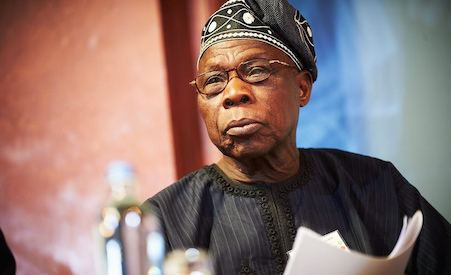
Former President Olusegun Obasanjo has launched a blistering attack on President Bola Tinubu’s economic reforms, accusing the administration of worsening the living conditions of Nigerians and deepening the country’s poverty crisis.
Obasanjo spoke on Wednesday at the Financial Times Africa Summit 2026 in London, United Kingdom, where he criticised the administration’s management of the naira, the removal of the petrol subsidy and the broader economic policies implemented since Tinubu assumed office in May 2023.
The former president was particularly critical of the depreciation of the naira following the Federal Government’s foreign exchange reforms.
According to him, Nigeria’s integration into the global economy means that changes in the value of the naira have a direct impact on the welfare of citizens.
“We do not live in isolation as a country. We interact with the rest of the world. And overnight, you devalue the currency by 300 percent.
“The naira went from N500 to a dollar to N1,500 to a dollar. What that meant was that every Nigerian is made poor by 300 percent. That made Nigeria become the poverty capital of the world, which means Nigeria has the largest number of poor people in the world.
“You cannot say to me that that is good for Nigeria. You cannot say to me that that is good for us in any sense,” he said.
The former president also dismissed the argument that Tinubu needs additional time to consolidate his economic reforms.
Asked whether he believed the Nigerian economy was improving, Obasanjo said he could not see any significant improvement.
“For the economy, I don’t see anything getting better,” he said.
He questioned the rationale for asking Nigerians to support another term for Tinubu on the basis that the President needed time to complete his reforms.
“What policies are you seeing through? You impoverish your people and you want to see impoverishment through? What are you seeing through?” Obasanjo asked.
He stressed that his criticism was directed at the President’s economic policies rather than his personality.
“What he is doing wrong and what I am saying is that the economic programmes that he has put in place are not in the best interest of Nigerians. Pure and simple. Nobody can deny that,” he said.
Obasanjo’s comments come amid continuing debate over the impact of the Tinubu administration’s reforms, which the government has consistently defended as necessary measures to correct structural distortions and place the economy on a sustainable path.
Tinubu’s economic reform programme began with the removal of the petrol subsidy in May 2023, followed weeks later by sweeping changes to the foreign exchange market.
The administration said the measures were necessary to eliminate distortions, improve market efficiency, attract investment, strengthen government finances and create the foundation for sustainable economic growth.
However, the reforms were accompanied by a sharp depreciation of the naira, higher inflation and a steep increase in the cost of imported goods and raw materials.
The consequences were felt across the economy, with food, transportation, housing, energy and other essential expenses rising significantly.
For households whose incomes did not increase at a comparable rate, the result was a substantial erosion of purchasing power.
Obasanjo argued that the impact of the naira depreciation could not be separated from the welfare of ordinary Nigerians.
His claim that the development made “every Nigerian” 300 percent poorer reflects his description of the effect of the exchange-rate movement, rather than a formal statistical measurement of individual wealth losses.
Obasanjo also criticised the manner in which the petrol subsidy was removed. He argued that a significant portion of what had been described as subsidy was actually the product of corruption in the petroleum sector.
“Petrol and petroleum products affect everybody and everything. Now, what we call subsidy for petroleum products in Nigeria, a lot of it is corruption,” he said.
According to him, the government could have reduced the burden of subsidy by first tackling corruption and leakages in the petroleum sector.
“I believe that if we pay attention to corruption and deal with corruption, then what will remain of subsidy will be very little,” he said.
Rather than relying on policies that impose additional pressure on citizens, Obasanjo called for stronger action against corruption, waste and excessive government expenditure.
“If you are in a very bad economic situation, two things among others to me are very important. You must curb corruption, wastefulness and unnecessary luxury,” he said.
He also stressed the importance of increasing domestic production.
“Number two, you must produce,” the former president said.
Tinubu inherited an economy already facing significant challenges, including high debt-service costs, foreign exchange shortages, petrol subsidy payments, low productivity and widespread insecurity.
His administration responded with two of its most consequential economic decisions in 2023 — the removal of petrol subsidy and the liberalisation of the foreign exchange market.
The policies initially triggered significant economic disruption. The naira depreciated sharply, inflation accelerated and the cost of living rose rapidly.
The government, however, has maintained that the short-term pain is part of a necessary adjustment process and that the reforms are beginning to deliver macroeconomic benefits.
Nigeria has subsequently recorded periods of improved foreign reserves, increased investor confidence, stronger fiscal performance and greater stability in the foreign exchange market.
Yet the improvement in some macroeconomic indicators has not eliminated the hardship facing households.
Poverty remains widespread, while food and other essential costs continue to consume a large share of household incomes.
It is against this backdrop that Obasanjo has challenged the administration’s claim that the reforms are ultimately in the interest of Nigerians.
For the former president, the central measure of economic success should be whether ordinary citizens are becoming more prosperous, not simply whether government finances or selected macroeconomic indicators are improving.
His verdict at the London summit was unequivocal: economic policies that leave Nigerians poorer cannot, in his assessment, be described as being in the country’s best interest.