By Ayo Kehinde
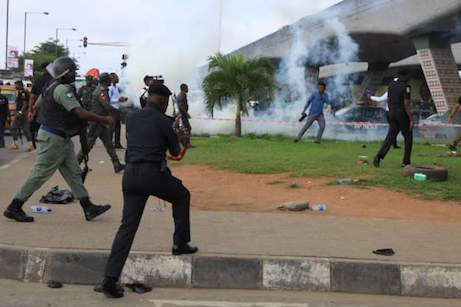
Policemen on Tuesday, fired teargas and dispersed residents, journalists and political figures gathered at the Lekki tollgate in Lagos for a memorial procession in honour of victims of the October 2020 #EndSARS protests.
The police action disrupted the procession marking the sixth anniversary of the protests and prevented participants from laying wreaths in memory of those who lost their lives during the nationwide demonstrations against police brutality.
Among those caught in the dispersal were Gbadebo Rhodes-Vivour, the governorship candidate of the African Democratic Congress (ADC) in Lagos State, and Funso Doherty, the governorship candidate of the Nigeria Democratic Congress (NDC).
The Enough is Enough (EiE) movement organised the procession as part of activities commemorating the sixth anniversary of the protests, which began with demands for an end to police brutality before expanding into wider calls for reforms in Nigeria’s policing system and improved governance.
The police officers had assembled at the Lekki tollgate before the memorial began. The officers subsequently fired teargas to disperse the gathering, forcing participants, including residents, journalists and political figures, to flee the area before the planned wreath-laying ceremony could take place.
Footage from the scene showed participants scrambling for safety as teargas spread around the tollgate.
The police intervention brought the memorial to an abrupt end and prevented organisers from proceeding with the planned tribute to victims of the 2020 protests.
The the Lekki tollgate occupies a significant place in Nigeria’s recent history following the events of October 20, 2020, when soldiers were deployed to the area while #EndSARS protesters were gathered there.
The incident triggered widespread condemnation and years of demands for accountability over allegations of shootings and deaths at the protest ground.
The #EndSARS protests had erupted earlier that month following longstanding complaints against personnel of the now-disbanded Special Anti-Robbery Squad (SARS), including allegations of extortion, arbitrary arrests, torture and extrajudicial killings.
What began as a campaign demanding the disbandment of SARS rapidly spread across several states and developed into a broader movement demanding police accountability, institutional reforms and improved governance.
The Federal Government subsequently announced the dissolution of SARS, while judicial panels were established in several states to investigate allegations of police brutality and provide redress for victims.
In Lagos, the State Judicial Panel of Inquiry on Restitution for Victims of SARS-Related Abuses and Other Matters investigated complaints of police brutality as well as the events surrounding the October 20 incident at the Lekki tollgate.
The circumstances surrounding the Lekki incident, particularly the number of casualties and responsibility for what happened, have remained subjects of controversy and competing accounts.
Six years after the protests, rights advocates have continued to raise concerns over allegations of police brutality, extortion and unlawful detention, arguing that reforms introduced in the aftermath of the demonstrations have not sufficiently addressed longstanding abuses within the policing system.
Civil society organisations and activists have also continued to commemorate the anniversary of the protests, with the Lekki tollgate remaining a symbolic venue for remembering victims and renewing demands for police accountability.
Tuesday’s memorial was intended to continue that annual remembrance with a procession and wreath-laying ceremony.
The programme, however, was halted after police operatives fired teargas and dispersed the gathering before the wreaths could be laid.