

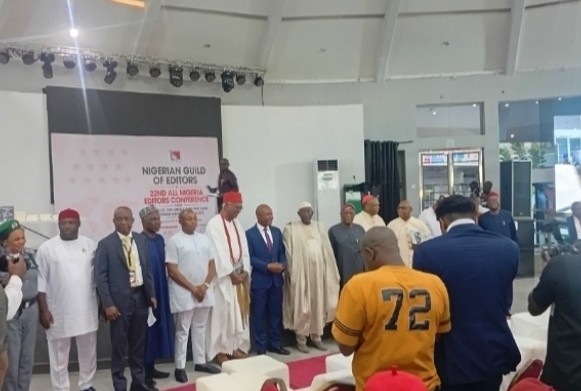
Free and fair election that confers legitimacy on elected representative and ensures inclusivity was the central theme at the just-concluded 22nd All Nigeria Editors Congress organized held from September 23 to 26 in Enugu.
The Nigeria Guild of Editors organized the conference.
Speaker after speaker harped on the inclusivity that is due to the credibility and integrity of elections.
Starting with the keynote speaker, Archbishop Emeritus of Abuja, Cardinal John Onaiyekan, who addressed the theme of the conference, “The Ballot, the Media and the Task of Keeping Democracy Alive,” with the sub-theme, “When Lies Look Real: Detecting and Debunking AI Misinformation Before, During, and After Elections,” said the people’s votes must count in the election of their representatives and not the law courts, which unfortunately have, more or less, assumed that role through litigation of election outcomes.
The Judiciary’s role is to adjudicate disputes arising from elections and not to become the instrument for imposing candidates on the electorate.
He said, “The judiciary is supposed to be the last stage in the electoral process. It should be stressed that the judiciary is not to determine elections about who wins, but rather to adjudicate disputes when they arise. If elections were well conducted, there ought not to be any need for the judiciary. Our experience in the recent past has almost become that we have been witnessing a situation where our elections are being determined not at the polls, but in the courts by the tribunals. This gives a field day for high-class lawyers with high-level fees, doing their best to manipulate issues on technicalities,” adding that “There are allegations that are difficult to deny of unjust judgments by some judges in election tribunals,” he said, adding that the performance of the judiciary in recent elections had “seriously dented the image of this hallowed institution.”
According to him, the judiciary was originally intended to adjudicate disputes arising from elections, not to become the institution through which electoral victories were effectively determined
He said, “The judiciary is supposed to be the last stage in the electoral process. It should be stressed that the judiciary is not to determine elections about who wins, but rather to adjudicate disputes when they arise if elections were well conducted, there ought not to be any need for the judiciary. Our experience in the recent past has almost become that we have been witnessing a situation where our elections are being determined not at the polls, but in the courts by the tribunals. This gives a field day for high-class lawyers with high-level fees, doing their best to manipulate issues on technicalities,” adding that “There are allegations that are difficult to deny of unjust judgments by some judges in election tribunals,” he said, adding that the performance of the judiciary in recent elections had “seriously dented the image of this hallowed institution.”
For the Chairman of the Independent National Electoral Commission, INEC, Joash Amupitan, represented by Enugu REC, Chukwuemeka Chukwu, the ballot is the instrument of a sovereign choice. Yet, a ballot in isolation is silent; it requires an informed electorate to give it intent and an institutional mirror to reflect its outcome truthfully to the world. That mirror is the media.
“Without a free, rigorous, and courageous media, citizens vote in the dark. Conversely, without a credible, transparent, and legally sound electoral process, press freedom becomes an empty exercise in documenting administrative failure. The electoral management body and the press are bound in shared constitutional stewardship: we protect the ballot, and you protect the truth surrounding it, he said.
“As Albert Camus aptly put it, ‘Integrity has no need of rules.” However, in discharging our national duties, our rules and professional standards are our shield. We must remain above suspicion before over 200 million Nigerians and the international community. A flawed election process or a corrupted information space is a wound to the nation’s soul. Together, we must ensure that under our watch, that soul remains vibrant and intact.
The immediate past president of the Nigeria Bar Association, NAN, Afam Osigwe, a Senior Advocate of Nigeria, SAN, said the increasing involvement of the courts in electoral contests had raised fundamental questions about whether elections were being determined by voters or through litigation. “I see that Nigeria is one of the countries with the highest number of election petitions, and all because the courts are very frequently involved in determining either the outcome or who won,” Osigwe said.
President of the Nigerian Guild of Editors, organizers of the conference, Eze Anaba said that, “the credibility of the ballot must be protected so that the courts do not have to replace the citizenry in determining who should represent them.
Presidential candidate of the Nigeria Democratic Congress, Peter Obi, urged editors to demand issue -focused campaigns from politicians as the best way to secure a free and transparent 2027 election.
For Professor of political economy, Patrick Utomi, the consequences of a failing electoral system go beyond elections. He warned that weak institutions could ultimately undermine the stability and survival of the country. If the people are convinced that there is no point, what is an election? Imagine the amount of money we waste to have elections that are totally meaningless because they do not legitimise anybody,” he said, adding, “What has happened to us, unfortunately, is because the abnormal has become so accepted that the transaction costs of engaging in Nigeria are such that we are only heading in one direction — ultimate collapse.”
Senior Special Assistant to President Tinubu on Media and Special Duties Tunde Rahman said the ballot is the only thing that makes a market woman equal to a billionaire.
“For four hours on election day, they have the same power, ” he said, adding that, “Our job as political actors and as government is to protect that power, to ensure that votes count, that BVAS works, and that INEC remains independent. But elections are not enough. Elections can produce the wrong outcome if the people are not informed. That is where the editors come in.”
Other key personalities present at the august occasion were Minister of Information, Mohammed Idris; Obi of Onitsha, Igwe Alfred Achebe; and the host governor of Enugu State, Dr Peter Mbah of Enugu State. Others were Governor Umar Namadi of Jigawa State; Deputy Governor of Enugu State, Ifeanyi Osisi; Publisher of the Vanguard, Mr. Sam Amuka; former governor of Ogun State, Olusegun Osoba; and Information Minister, represented by Ali. M. Ali, the Managing Director of the News Agency of Nigeria, NAN. Prof. Auwal Yadudu, a senior advocate of Nigeria, SAN; Chief Onyema Ugochukwu; Prof. Stella Ọkunna; and the INEC chairman also made the list of speakers.
