Continued from yesterday & concluded
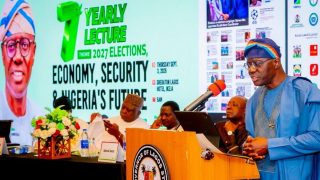
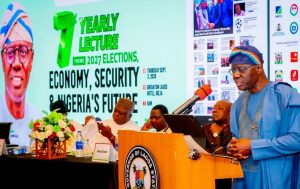
Text of the lecture delivered by Mr. Babajide Olusola Sanwo-Olu, Governor of Lagos State, at the Freedom Online 7th Yearly Lecture, Sheraton Lagos Hotel, Ikeja, on Thursday, 3 September 2026.
Protocols.
…Then there is State Policing. When it is completed, it will rank among the most consequential reforms in the history of this country, and I want to say something about it from experience rather than theory.
Lagos has been running a version of it for almost twenty years. The Lagos State Security Trust Fund, created in 2007, pools contributions from the private sector and the State to equip the police and the other agencies that keep this city safe. Our Neighborhood Safety Corps puts men and women from every community on the ground in that community.
The lesson of two decades is not complicated. Security works best when the people who pay for it and the people who depend on it can see, and hold to account, the people who provide it. That is the whole argument for State Policing in a single sentence.
The President understands this because he governed this State. His conviction about devolving power to the grassroots is the same conviction behind his fight for full financial autonomy for local governments, which the Supreme Court affirmed in July 2024. State Policing will require amendments to the Constitution, which means the National Assembly and our State Houses of Assembly. Whoever sits in the next Assembly, I hope they will finish the job.
We speak of the economy and security as though they were two subjects. They are one. Poverty feeds insecurity, and insecurity strangles the very economy that would cure poverty. When a farmer cannot go to his farm, the nation gets hungrier. When a school is not safe, the country gets another cohort of children who never learned to read. And the reverse is just as true. The most effective security policy is a job, and the surest guarantee of a job is a country safe enough to invest in.
Lagos is the proof. Every business that opens in this city is a vote of confidence in the safety of this city. We did not attract the Lekki Deep Sea Port, or build the blue and red rail lines, or draw the investment that has made Lagos the technology capital of Africa, by accident. We did it because, first, people had to believe that Lagos was safe enough to bet on. That is the nexus. I have not read about it. I have lived it for seven years.
38. It is why the President’s interventions have gone straight at the poverty that feeds insecurity, and straight at the demographic with the most to gain or to lose: our young people. Nigeria has one of the largest youth populations on earth. That is either the greatest dividend in our history or the greatest danger to it, depending entirely on what we do in the next ten years.
The Nigerian Education Loan Fund is keeping students in school who would otherwise have dropped out. The Consumer Credit Corporation is building the credit culture without which no modern economy functions. The 3 Million Technical Talent program is training the workforce of a digital economy. The recently unveiled reform of the National Youth Service Corps is turning a year of service into a year of enterprise.
And behind these stand the Nigerian Youth Academy, the Nigeria Health Fellowship, the Student Venture Capital Grant, the Power Force program and the Labor Employment and Empowerment Program. It is hard to name an administration that has invested in young Nigerians on this scale.
Our elections have improved. Anyone who covered the elections of the 2000s, as many in this hall did, knows how far we have come, and much of that distance was travelled on this party’s watch: the Electoral Act of 2022 and now the Electoral Act of 2026, and the technology that verifies voters and transmits results. But this is not the moment to rest on our oars. INEC must be ready in every polling unit on the 16th of January and again on the 6th of February, and each of us has a duty to help it be ready.
I want to say something about the President and this process, and I want to say it with a recent example, because an example is worth more than an assurance.
Nineteen days ago, on the 15th of August, the people of Osun State elected a governor. The candidate of my party, the President’s party, lost. The incumbent, Governor Ademola Adeleke, of a different party, won by more than sixty thousand votes. The President did not sulk and he did not equivocate. He picked up the telephone the following day, congratulated the winner, urged him to unite the State, and thanked INEC and the security agencies for a peaceful and transparent election. Governor Adeleke has since publicly thanked the President for ensuring a level playing field.
Think about what that means. There was a time in this country when “federal might” was a phrase that a ruling party used without irony. Under this President, the ruling party can lose a state, in the South-West, in an election year, and the sky does not fall. That is what a maturing democracy looks like. This President is a lifelong democrat, and he means to leave behind a stronger democracy than he inherited, not only for Nigerians but as an example to a continent that badly needs one.
And let me add one sentence for every candidate and every party, my own included. A mandate is only as strong as the process that produced it. No office in this land is worth the life of a single Nigerian, and no victory won by the wrong means is a victory at all.
Distinguished ladies and gentlemen, you cannot discuss 2027 and leave out the 36 governors. Nigeria is not one economy but thirty-seven: 36 States and the Federal Capital Territory. The people who manage those economies will decide much of the outcome of this election, whether they mean to or not.
Voters may not be economists, but they are excellent accountants. They know whether their State built the road it promised. They know whether the primary health center has a nurse in it. They will bring that ledger with them to the polling unit.
Let me be candid with my colleagues, because I have sat where they sit for seven years. Under this President, the States have had it very good. Since the subsidy was removed, the monthly allocations to States and local governments have more than doubled in naira terms. The President has done his part; the money is arriving. What is done with it is on us. The excuses have been removed, and the electorate knows it.
Distinguished ladies and gentlemen, no discussion of our future is complete without the world beyond our borders, and here I want to be careful, because the temptation in an election year is to pretend that everything that happens to Nigeria is decided in Nigeria.
It is not. Oil prices, the wars in Europe and the Middle East, the interest-rate decisions of the world’s major central banks: these move our economy, for good and for ill, and no President controls them. What a government controls is how it responds, and the test of any response is whether it protects people’s livelihoods, businesses and industries while the shock passes through. I believe this government has passed that test more often than not, and I believe the reserves and the naira are the evidence.
The same is true of security. Our neighbors’ wars do not stay on their side of the border, and our borders are long. We must keep our eyes on the region and keep improving our early-warning and response systems. The President’s recent decision to set up a high-level panel to produce a National Threat Assessment and a Five-Year Strategic Defence Operations Plan is exactly the kind of planning a serious country does.
This is also where the President’s foreign policy has quietly delivered. It has had two objectives: bring investment in, and bring security partners in. On investment, the verdict of the market is in. The Nigerian stock market has been one of the best-performing in the world this year, and the value of the companies listed on it has grown more than five-fold since 2023.
On security, we now have partners who are not merely sympathetic but present. In July, President Trump wrote to President Tinubu to say that it was, in his words, “a true honor to stand with you in the fight against terrorists.” Behind that sentence stand a Defense Cooperation Roadmap, a joint working group led by the national security advisers of both countries, and joint operations that have already produced results.
Distinguished ladies and gentlemen, I want to end where the theme ends: with the future.
There is a future beyond 2027, and it is a bright one. The President has set the destination: a one-trillion-dollar economy by 2030. I know there are people who scoff at that number. People also scoffed at reserves of fifty billion dollars, and at a billion dollars a month in remittances, and at a stock market worth more than 150 trillion naira. Set the target, do the work, and let the scoffers keep the score.
We have moved past the era when every election felt like the one that might end the Republic. When the 2027 elections are done, 2031 will come, and then 2035, and 2039. That confidence, which our parents never had, is itself an achievement of this democracy, and we should say so.
I will not disguise my hope for the outcome. I expect my party to win, and I expect a second term for President Tinubu to consolidate the Renewed Hope agenda, because an unfinished reform is the most expensive kind. But whatever the outcome, I expect the election to be peaceful, I expect the loser to concede, and I expect Nigeria to add one more milestone to its record.
And now, the harder request I promised you at the beginning. It is for you. The fourth estate holds immense power in an election season, and power carries obligation. To whom much is given, much is expected.
I am not asking for a compliant press. A compliant press is of no use to a democracy; it flatters the powerful and abandons the public. I am asking for a rigorous press. Check the facts, mine included. Call out disinformation wherever it comes from, including from my own side. In the weeks ahead, the most dangerous lies will not come from newspapers. They will come from anonymous accounts and doctored videos, and you are the institution best placed to answer them.
I am asking you to look where others do not. Our deputy governorship candidate in Lagos is a woman, extending a tradition in which women have held that office four times out of seven since 1999, including an unbroken run from 2007 to 2019. Women remain badly under-represented in our politics; cover the women who are running. Young people are trying to break in; cover them too.
And I am asking you to tell the whole story. I am not asking you to hide this country’s problems. I am asking you to give the same energy to what is working: the business that opened, the student who got the loan, the town whose road finally arrived. There is a place for patriotism in journalism. Patriotism is not propaganda; it is the refusal to let those who wish this country ill have the last word about it.
Distinguished ladies and gentlemen, one hundred and thirty-five days from now, Nigerians will do something no generation before ours ever did: elect a President, peacefully and on schedule, for the eighth time in succession.
Nigeria’s future will not be decided on the 16th of January. It will be decided by what we do with the mandate that the 16th of January produces: whether we finish the reforms or abandon them halfway; whether we complete State Policing or leave it on the drawing board; whether we turn our young people into a dividend or a grievance; whether we build the one-trillion-dollar economy or merely talk about it.
Our elders say that one hand cannot lift a load onto the head. The Federal Government has a part. The States have a part. INEC has a part. And you, the fourth estate, have a part that no one else can play.
Let us lift this load together, and let 2027 be remembered not as the election Nigeria survived, but as the election at which Nigeria came of age…