By Temitope Mustapha, Abuja/Nigeria.
Prior to his journey to borstal home, Ilorin, Kwara State, Nigeria, 18-year-old Nuel had abused drugs and substances such as codeine, cannabis and refnol.
And while doing that, he also had stolen valuable items before he was eventually sent to the correctional facility in March 2019.
Booked for 3-year-term, Nuel is among the 161 children kept in custody of the Borstal Training Institute in Ilorin.
The population consists of students from Kwara State, 76; Nasarawa has 9; Anambra, 8; Oyo state with 12 while others are from the North-West, North-Central, South-East and South-South.
At first, Nuel experienced withdrawal syndrome for almost six months, which, according to experts, include anxiety, fatigue, depression, and hallucinations among others. But he is now doing better.
Now, he thinks staying behind at the institute might not be a bad idea. Through consistent counselling, he has decided to focus on his education. He prefers academics to acquiring vocational skills, the two major tools of rehabilitation at the borstal home.
His story is not so different from 24-year-old Femi, who was admitted into the Institute due to his addiction to smoking gum. The habit had transformed him into a tormentor of his parents ‘peace of mind, before they finally handed him over to the authorities of the borstal home.
“My physical appearance during this five year when I used to smoke gum and drink codeine was a reference point of sadness hence, my parents just wanted me away from home, that is why they brought me here,” he narrated.
Officials of the Institute said none of the children is in conflict with the law, apart from those reported for committing minor theft. Majority are drug addicts and are uncontrollable by parents.
To prevent the young boys from absconding, the Institute locks them up in the dormitory for mostly 18 hours every day. They hardly see anyone from outside except family members, who rarely visit.
Nuel and Femi are, however, privileged to have their relatives checking on them monthly unlike others.
Majority of the children at the borstal home come from broken homes, therefore, some of the children presently may not have a home to return to after spending 3 years in the Institute, a staff said.
One of the unlucky juveniles is Timothy. He was supposed to have been discharged since March 2020, but he is still at the facility as of September, because his mother who is supposed to pick him from the Institute said she has been affected by lockdown in Ghana as a result of COVID-19 pandemic.
Timothy’s story is a reflection of the experience of other teenagers at the borstal home in Ilorin, as only 20 percent of children in the juvenile home have the opportunity of their families checking on them, according to Mrs Abimbola Ogunyemi, the school principal, who doubles as the Controller of Corrections.
“Parents are meant to visit their wards once every month but, as it is, the majority of parents just dump their wards here and they don’t return to check on them as expected,” she lamented..
The attitude of parents stems from the belief that the borstal homes are resourceful enough to cater for their wards in their absence. Oftentimes, this is not so.
Though section 234 and 236 of the Child Rights Act mandates welfare homes to provide accommodation, education or vocational training, employment and other support, and ensure that the child does not leave the institution educationally disadvantaged, and the Ilorin Borstal Training Institute tries to do this, but could only achieve a little. Instead, the borstal home runs like an adult prison.
“Their conditions are not too different from those of adults in conflict with the law, like the prisons, their being locked up in the dormitories appears more punitive than rehabilitation,” a staff member told The ICIR in confidence.
First, the location of the Ilorin borstal home is hardly accessible by road, especially to potential donors. The road leading to the facility from Ganmo –Afon junction has been washed away by erosion.
Ten out of 12 dormitories are functional, and shelter over 160 youths. Thus, not fewer than 19 inmates are huddled together in a room where they share a pit toilet with the bathroom.
The windows have no nets nor louvers except for the burglaries holding the window frames, exposing the occupants to inclement weather and insect bites.
The bathroom and toilets are located in the same place they sleep, and the whole dormitory is frequently enveloped with stench odour.
The Institute though has workshops such as tailoring, welding and knitting centre but they are all in poor condition. Save for the tailoring centre, others are ill-equipped.
Older students of the Institute under close surveillance are engaged to repair the students’ beddings when the need arises.
The classrooms are also inadequate, and the few ones are bereft of furniture and teaching aids such as computers. The only laboratory in the school has no equipment.
Though there are Table Tennis and volleyball courts, the football field is overgrown with grasses.
There are a few bags of foodstuff in the store, an indication that children are not starving.
The daily menu comprises only beans, rice and eba, according to an alumnus of the Ilorin borstal home.
The Institute runs a functional sick bay managed by a nurse who has served in the school for 10 years. But she is the only health officer now left in the entire institution.
The psychologist, who used to assist her left about four years ago. But no one cares much because malaria seems to be the major sickness afflicting the children.
The large expanse of land hosting Ilorin borstal home is heavily guarded by officers of the Nigerian Correctional Service.
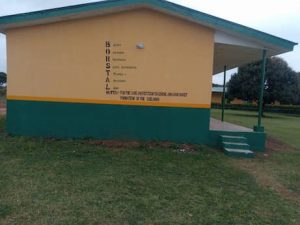
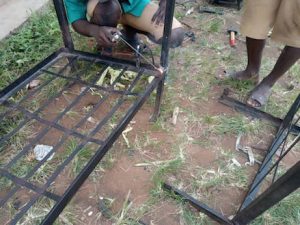
Profile view of the school and students engaged in welding, one of the skills to be acquired there.
Our Experience at Borstal Home, Ex- Students Narrate Experience
Former residents of the borstal home shared their experiences with The ICIR. Temidayo was at the home 2008 and 2010.
“They used to lock us in, the officers would release us for one hour in the evening between 4-5pm for sports, then we do have prep time for another one hour for some of us preparing for junior WAEC to study, some use the opportunity to wash their clothes.”
Temidayo, a truant at school, was first taken to remand home in Oko-Erin, Ilorin, Kwara State, before he was transferred to Ilorin borstal training Institute, where he spent 2years.
He was in junior secondary school when he joined borstal home and sat for junior WAEC in the Institute.
“I learnt my lessons at the remand home first before I was taken to borstal again, they used to chain our two legs but during evening period they will lose one chain then at the remand home, due to the strenuous treatment I came back to my senses but my mother was not still satisfied ,she complained to the judge that I was not reformed at the remand home, the Chief judge yielded to her plea and she secured a warrant that landed me in Ilorin borstal home. I was in Borstal Institute for two years, between 2008 and 2010, I was 14 years then, we were about 92 students during my set”.
Temidayo said the condition of the institute then might have contributed to why some students used to escape from the home.
“There was a time we suffered water shortage between 11months to a year, they would select few students to fetch from outside then. Then the pits toilet in the dormitories were dilapidated ,they need to renovate the toilets ,then the septic tank, we would use sand to cover-up bad spots, back then in my dormitory we were 25 people with two pit toilets, it was even dilapidated but the junior students used to wash it, the highest number of students in a dormitory was 27 and we only had six dormitories as at that period”
Describing borstal as a wild world, he revealed how sodomy was rampant among students, and how some students smuggled cannabis into the school with the help of some officials.
“That is the place I ever first heard about sodomy among the students.”
He said the borstal institute had been 45 percent punitive and 55 percent reformative. “They used handcuffed for those with serious offence, like students that commits sodomy, those that attempted escape, and those that gets into fight every time, they handcuffed their legs and hands, they used to beat us with fan belts of lorry and trailer. Many students ran away, majority of whom came from outside, Ilorin. About 11 students ran away during my period of staying there, majority were taken back to the Institute, whenever they run away, they got lost, majority of them ran away with borstal attire.”
The 26-year-old revealed that inequality existed at borstal homes even though they were all brought in because of their anti-social behaviours.
“Some of the officers we had around then used to pamper the children of the rich than we that were vulnerable, if we committed offence, there used to be lesser punishment for the children of the rich people”.
Temidayo narrated how donors visited the institute with relief items and cash which some officials of the institution help themselves with.
“I remembered Mrs Toyin Saraki, wife of the former Senate President, visited us, some ministers, and some wealthy parents whenever they donated money, provisions or some relief materials, you will watch some officers share it among themselves, and give us small”
Temidayo called on the government to show greater care to children in borstal homes. He decried the manner at which the juveniles are locked up like prisoners.
He said the institute needs the services of a professional psychologist to help the children deal with different forms of challenges they face at the institute.
Jamiu also did not have a good account to give about his borstal home experience.
“The time I spent in borstal was very terrible. I cannot forget at all. Then we were more than 20 boys in my dormitory, and we all shared pit toilet and bathroom together in a place that is inside where we sleep, even our septic tank was terrible, the block was dilapidated”
Speaking about the food served at the institution, Jamiu said he hated the beans served every morning.
The ICIR asked the Public Relations Officer of the institution, Bamigbade Olumuyiwa, about the reason why they lock up the students for long hours, he said it was a way of protecting the children away from contracting COVID-19.
A child rights activist and education adviser, Riplington Education Initiative, Abiola Sanusi, decried the continuous use of old systems such as the dormitory system of keeping the children, saying it is a total violation of child rights acts.
Mrs. Sanusi emphasised the place of synergy between the Federal Ministry of Education and the Federal Ministry of Interior, saying the borstal homes need the services of experts such as specially trained guidance and counsellors, for the provision of psycho-social supports and intensive drug counselling for the juveniles.
She pointed that there is a need to properly engage the time spent by the children at the reformatory home, adding that keeping the children behind for 24 hours is damaging to their essence of being at the institute,
“These children are young Nigerians that must not be subjected to such treatment , children cannot be kept locked up in such institute , the key objective is the need for authorities to utilise those hours to engage them productively, we need to recognise this, the juveniles reintegration back into the society is most important, children cannot be kept locked up and expect them to be productive when they leave the borstal home”
“The present situation of children in borstal homes in Ilorin and across Nigeria shows that the federal government has not caught up with Lagos state module. If they are still using the dormitory and other old systems, it is a violation of child rights acts”
“There is need for synergy , in correctional facility like that , it is crucial to partner with the Federal Ministry of Education, the education experts , such as guidance and counselling , they will be the one to offer professional services of giving psycho -social supports and intensive drug counselling,’
Sanusi called for redirecting of resources towards proper rehabilitation of the children in the juvenile home, there must be synergy to achieve this aim, authorities must prioritise adequate provision of vocational and technical skill facilities.
“The environment and necessities of the school should be given more attention, these are the same young people that we expect to participate in building the society, so more attention is needed in the area of rehabilitation, so as to allow them to fully participate” she added.
Speaking with FIDA Kwara State Chairperson, Barrister Salmat Iyabode Muhammed, she expressed worry about the developments and queried why the children would be locked behind the bar when they are not in conflict with the law.
“We have been there in the past years, but in the past two years we’ve not been able to go there but now that we have this information we will go and find out should they have to be locked behind the bar”
The Children and Young Persons’ Law, CYPL, which gave legal backing to borstal home in Nigeria frowns against the maltreatment and neglect of juveniles and provides that juveniles must be properly lodged, fed, cared for and instructed.
Authorities managing the borstal home in Ilorin said drugs and food are provided to the school through contractors, many Non-Governmental Organisations, religious bodies, pay visits to the home to donate and give out relief materials to the juvenile.
It was further gathered that the NGOs also bring in computer systems to train the children inclined in academics.
I also learnt that heads of religious institutions visit occasionally to counsel the juveniles.
Among the gifts the children usually receive includes slippers, sanitary items, bathing soap, towel, blankets.
The Secretary of a group, Member of Muslim Media Practitioners of Nigeria, Moshood Sarumi, who paid visit to the borstal home recently, said the children displayed decency through their responses.
“I believe if the environment is more conducive, the reformatory agenda will be achievable within the time frame of nine months to three years that the law provides for a juvenile to be at the home, the authorities need to keep where the juveniles sleep more humane”.
“The school being a reformative institution needs more commitment from the government, if more attention can be given to the school it will reduce crime and social vices , the officials at the facility should also be trained specially on strategies to handle these children from preventing them from becoming more hardened ”
Dr Aiyeleso Oluwadamilare, a religious leader who visits the remand home regularly to counsel the children before the pandemic, noted that the government cannot do it all, and advised well-spirited members of the public to support the efforts of the government.
Oluwadamilare mentioned that consistent counselling is key to the rehabilitation of the juveniles.
Meanwhile, a Medical doctor, James Agbeluyi, expressed concern over the living conditions of the children and its consequence on the society.
Agbeluyi pointed out that the kind of welfare given to the children can in turn make them unhappy with society.
The medical expert specifically condemned the dormitory system of accommodating the children. He said that it is a threat to their health.
Meanwhile, Nuel and Femi were among 31 students of the institute who recently sat for WAEC and Joint Admissions Matriculation Board examinations and they both look forward to gaining admission into higher institutions to study Criminology and help other children in the society.
“We usually have one-hour Prep time, when they will allow us to prepare ahead of our next exams, we don’t have enough books in the library, but we make do with the few textbooks our parents make available for us,” Nuel said.
This report was carried out and sponsored by the Institute of War and Peace reporting, IWPR and the International Centre for Investigative reporting, ICIR under its Human Rights Accountability and Justice project.